
List of updates / new info. on Vox solid state amps (1967-1972)
2026
9th October
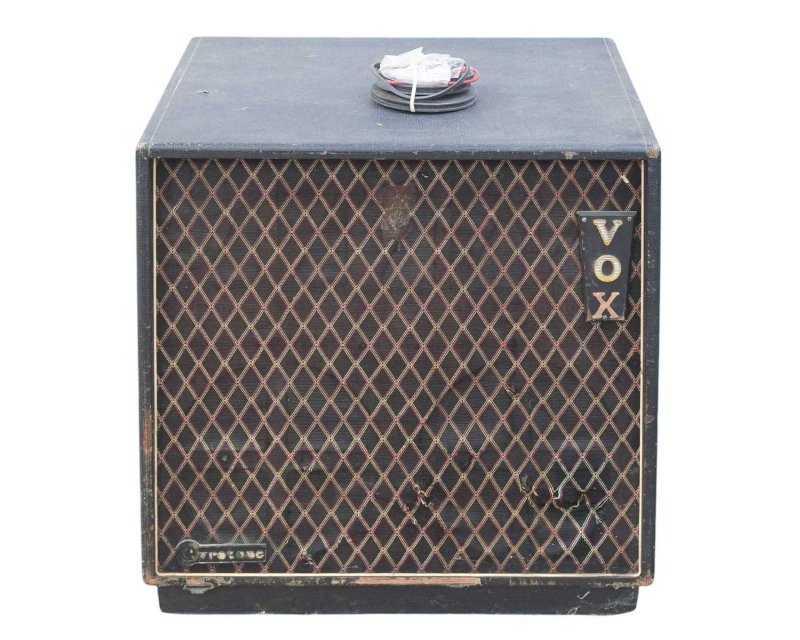
Old pictures of a further early Supreme speaker cabinet, its Celestion T1225s removed at some point and replaced in fairly random fashion.
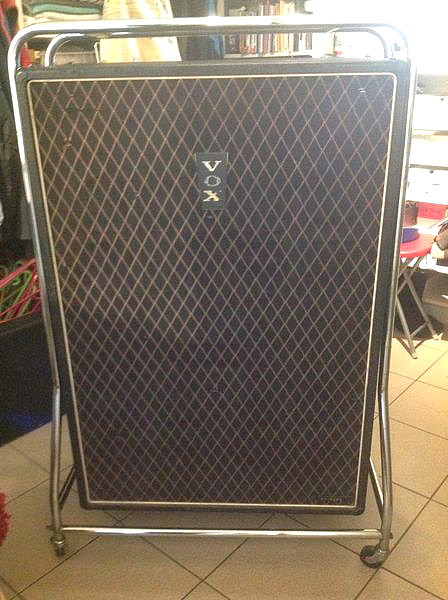
"VOX" (in silver) alone on the logo, no "Solid State".
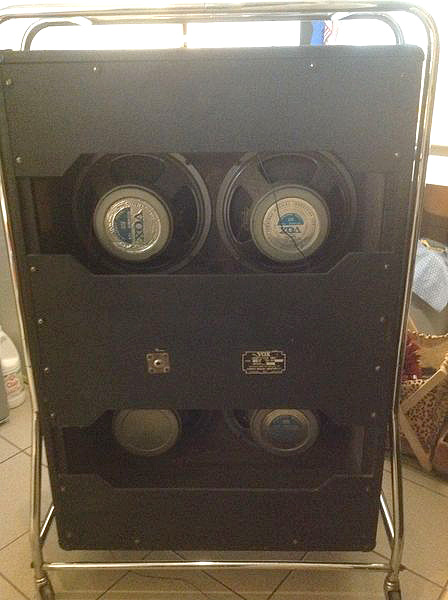
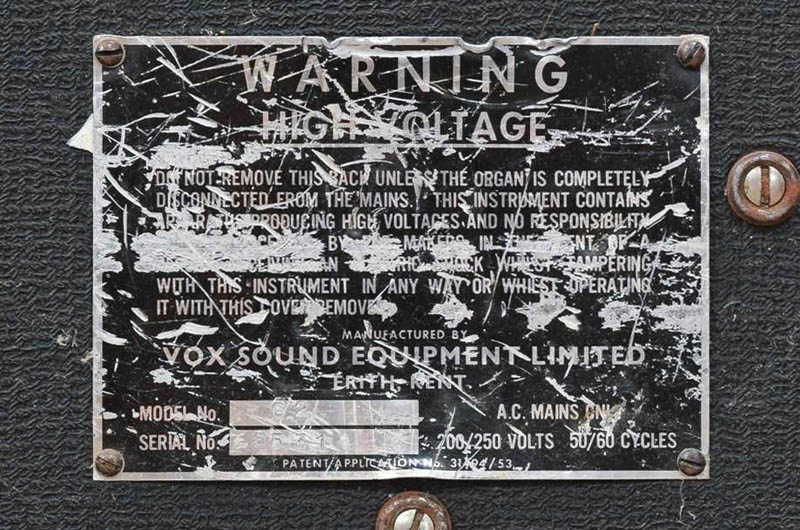
JMI plate on the back panel to the right of the (changed) jack socket.
25th September
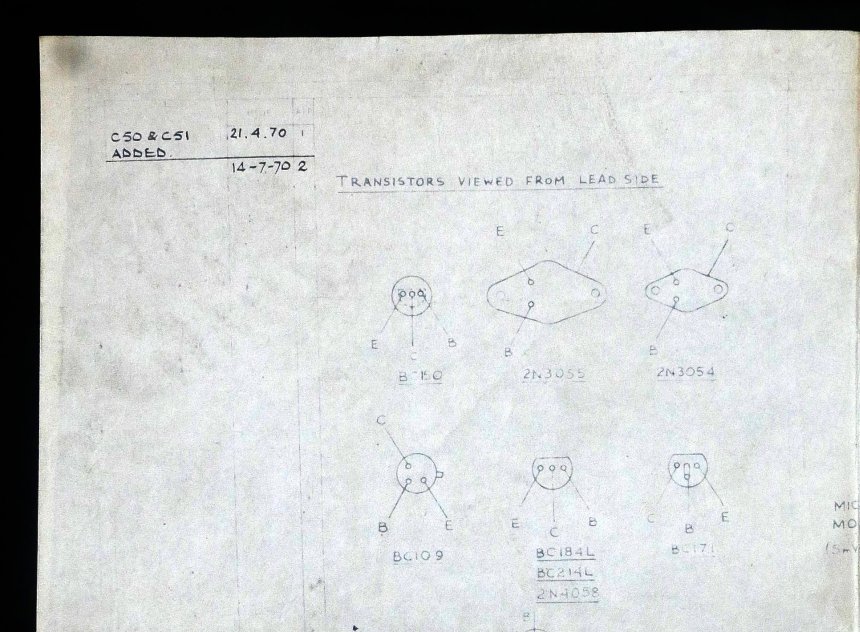
A detail of the upper left-hand corner of OS214 (for the Vox PAR100SS). Parts of the sheet are a little feint, so it may take some time to produce a useable digital copy.
12th September
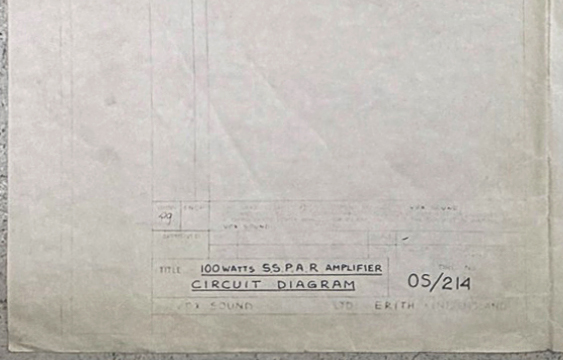
Recently resurfaced, a full-size copy of OS/214 - 40" x 30", copied from the master sheet in late 1970 - for the Vox PAR100SS. This appeared briefly a few years ago in the UK but quickly went to ground again. It was evidently made at much the same time (latest addition July 1970) as the sheet digitised and posted by Korg in the early 2000s. Further details to come.
4th September
Recently sold in the UK, Vox Supreme serial number 1099 with a non-standard speaker cabinet, the same width as solid state bass cabs (and with the type of chrome amplifier support supplied with those cabs), but shorter. Dynamic and Foundation speaker cabinets are normally 12 diamonds tall, this one is 10, half the height of a Super Foundation Bass.
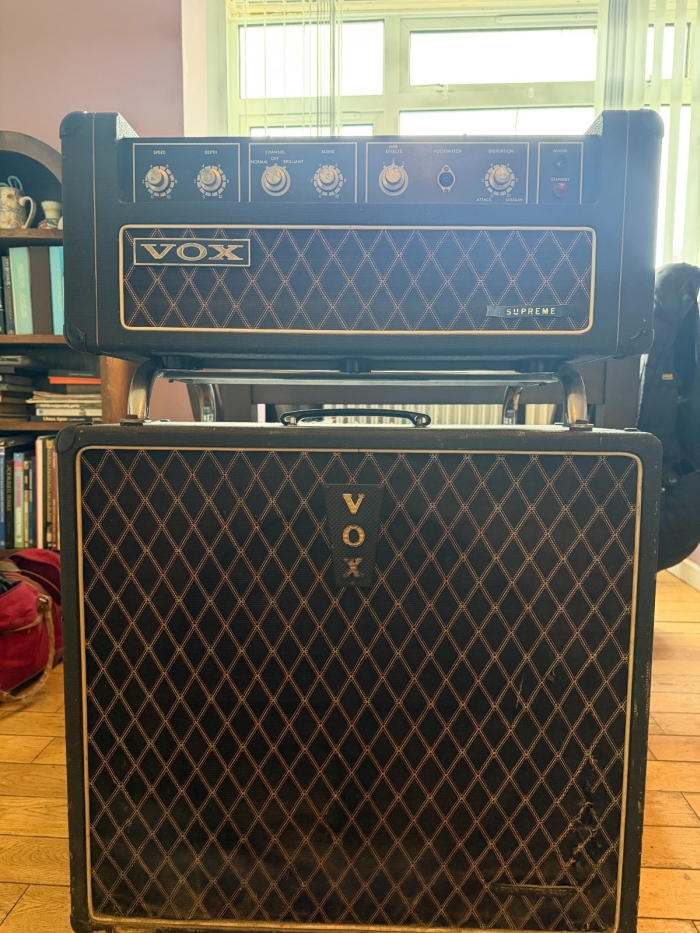
Cabinets produced for the solid state range are 17 diamonds wide. The AC50's Foundation Bass cab was 15. As noted above, 10 diamonds tall is half the height of a Super Foundation Bass.
3rd September
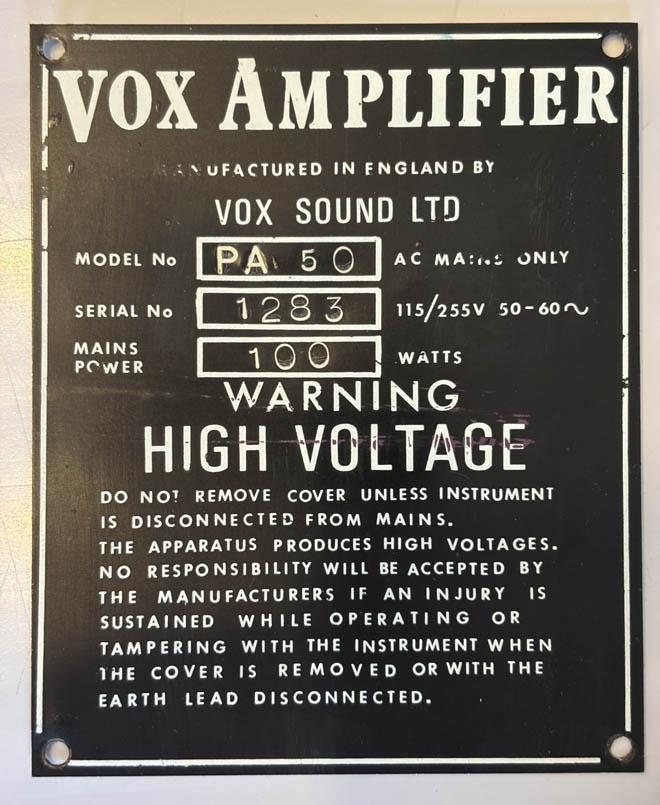
The companion page to the page linked in yesterday's entry has now been set up - Vox PA50SS serial number 1283 post restoration.
2nd September
A page has been started on Vox PA50SS serial number 1283 as it was prior to restoration. Thanks to Mark for pictures and details. A page to follow on the amp post restoration.
21st August
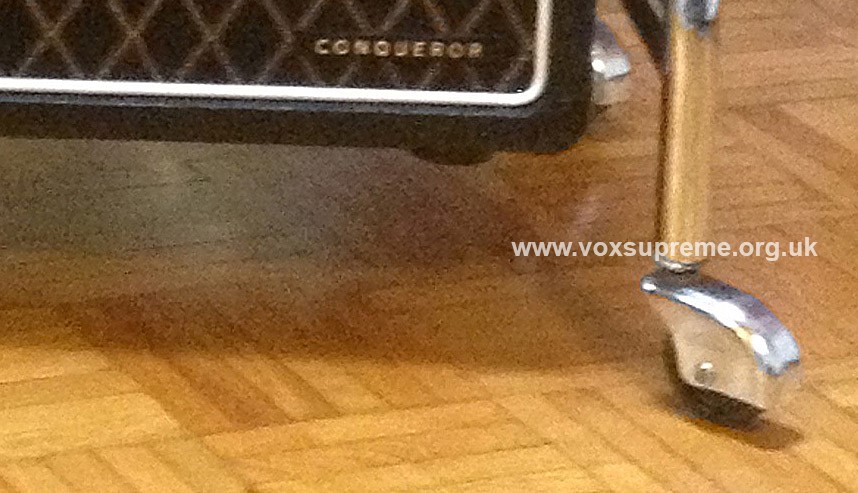
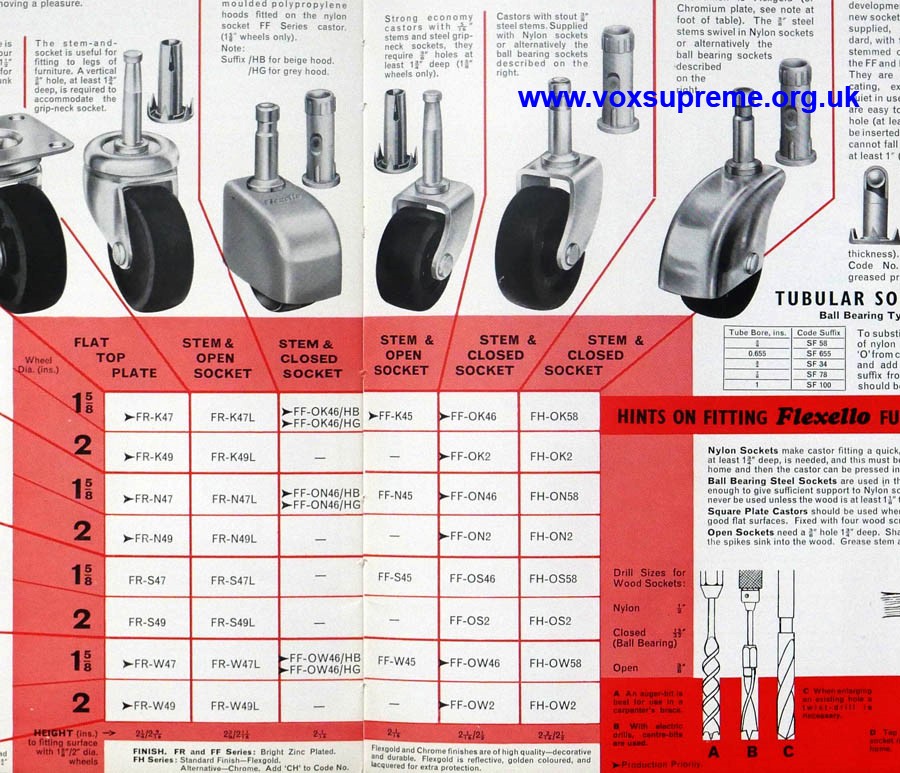
Really just a note to the effect that from late 1967 through to early 1969 the side stands of Vox Conquerors were often fitted with hooded chrome Flexello castors - type "FH-OK2" in the Flexello catalogue of February 1967, priced at 22 shillings for a boxed set of four.
11th August
Recently sold, a "Vox Sound Equipment Limited" Gyrotone II, relatively scarce these days. The serial number is 5531.
8th August
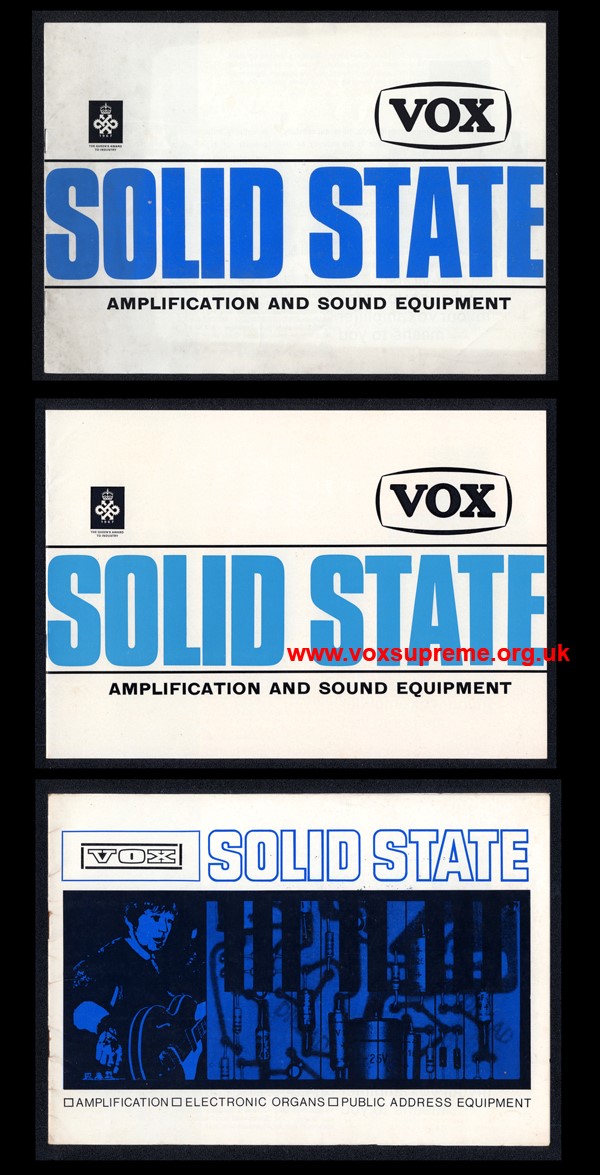
The three small-format (10 1/2" x 7 1/4") Vox solid state amplifier catalogues distributed in the UK, top to bottom: April/May 1967 (JMI); July/August 1967 (JMI); late 1968 (Vox Sound Equipment Limited). The two JMI versions have different legends for the Gyrotone. The guitar catalogues that accompanied were done in matching colours: April/May, dark blue; July/August, turquoise. Copies were occasionally sent to Europe.
7th August
Terry Walsh and Bobby Kevin's listing, mid May 1967, their first for their "Vox Solid State, Conqueror, everything built in".
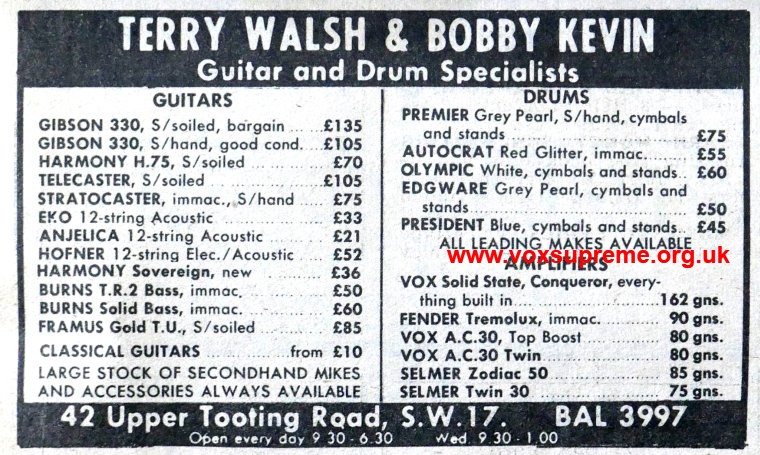
May 1967.
5th August
Tom Lee's shop in Hong Kong, picture published in early 1969 - a Defiant at left, and in the background (and front of shop), a good number of new Vox guitars. Also on show: an AC100, organs, a mixer unit, etc.
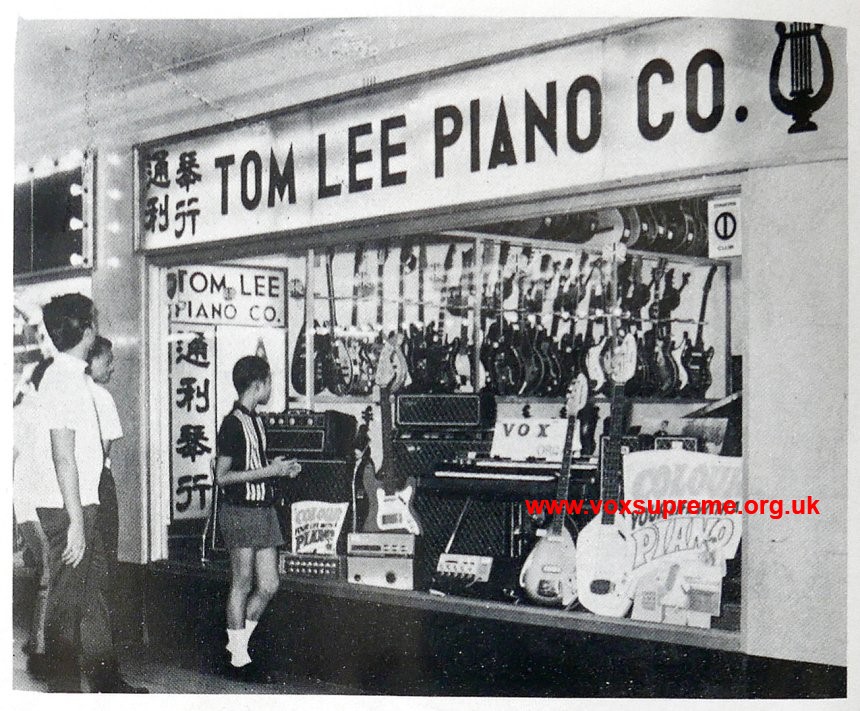
Early 1969. For a picture of Tom's shop published in 1967, see below, entry for 2nd August.
4th August
An early (late 1968) "Vox Sound Equipment Limited" Super Foundation Bass cabinet with an impedance matching transformer from factory. The two Goodmans 91/100s were presumably of the 15/16 ohm variety (the part number stickers give 2441/16), wired in parallel for a total of 8 ohms. The transformer will have matched the impedance required by the amplifier (15 ohms) with that of the cabinet.


The transformer is of the type used in the smaller (two output) impedance matching units.
3rd August
Linking back to other entries on this page (1st August, 27th July), a detail from the Vox catalogue printed for Mufag in March 1967, probably shortly after the Frankfurt Musikmesse, the "Virtuoso" still designated the "Supreme". Mufag was one of the three main agents that JMI had in Germany.
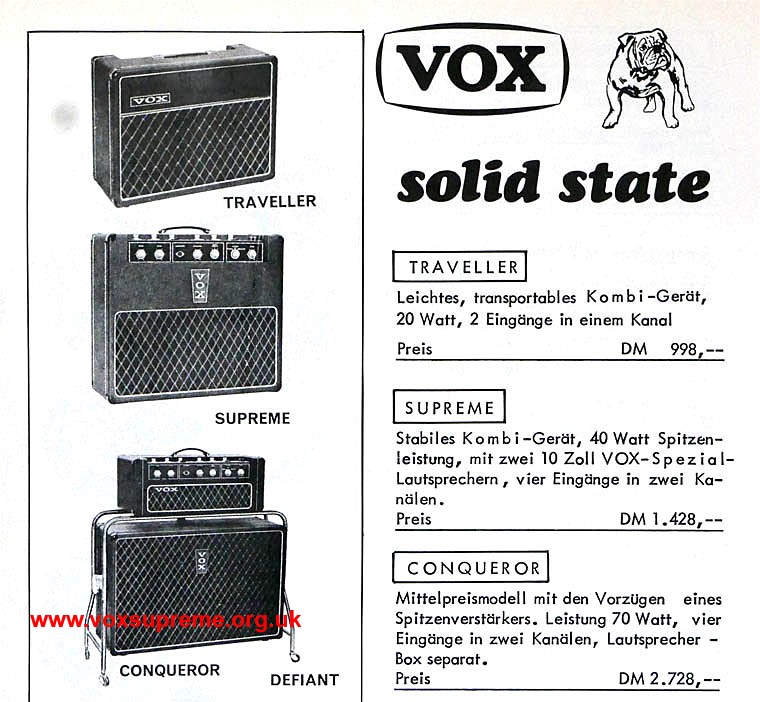
March 1967. Mufag produced an updated version of the catalogue in September.
2nd August
Local Kent press, March 1967: a note of Colin Barratt's sales trip to the Far East. One dealer in the region already on board - from at least 1966 - was Tom Lee in Hong Kong. Whether Colin's trip resulted in the solid state equipment on offer in Guam (east of the Philippines) is not known for certain at present - but it seems likely.
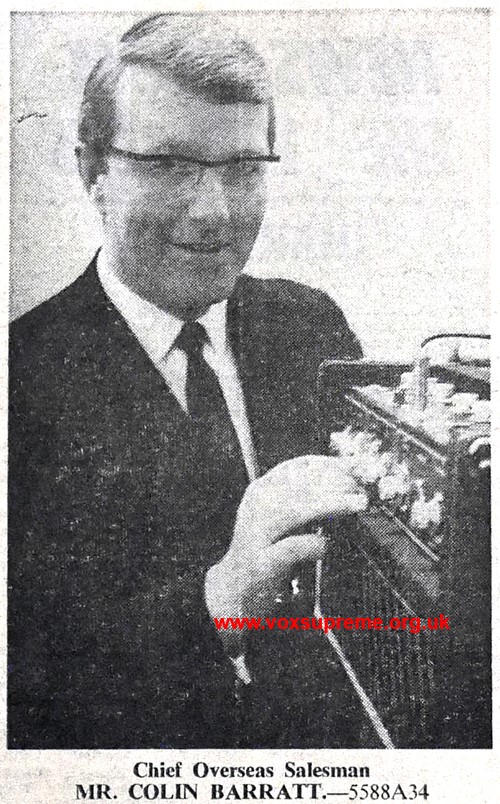
Local Dartford press, Colin with a Supreme, April 1967. He had been appointed Overseas Sales Representative by Tom in the summer of 1965. For three years before that he acted as JMI's Sales Rep. for the Midlands and Northern England.
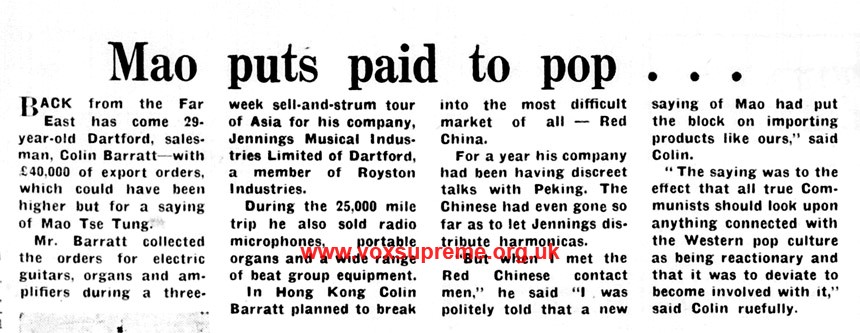
March 1967, sales of Vox radio microphones mentioned. Material on the system can be found on this page.
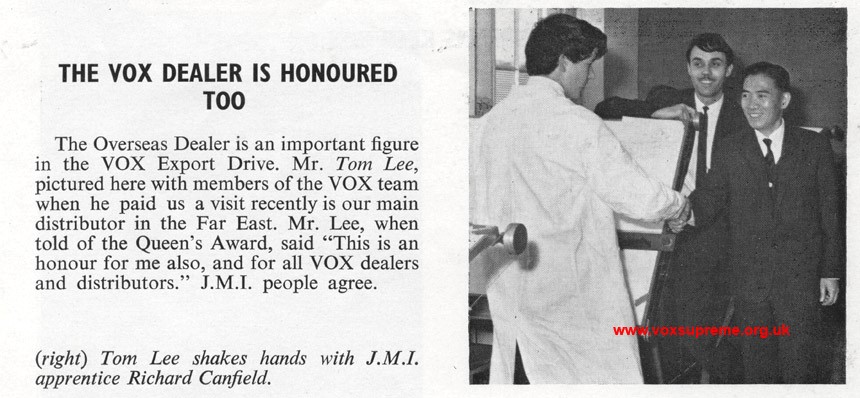
Tom Lee's visit to the West Street Works in April '67, picture published in July 1967. In the background Reg Clark, General Sales Manager.
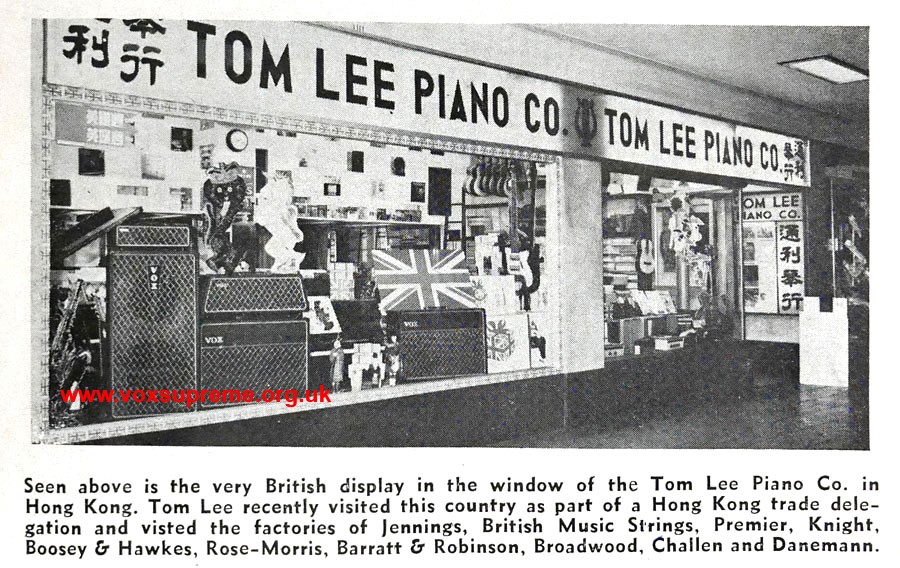
Picture published in May 1967, perhaps taken some time earlier. At any rate, there are no solid state amps visible in the main display.
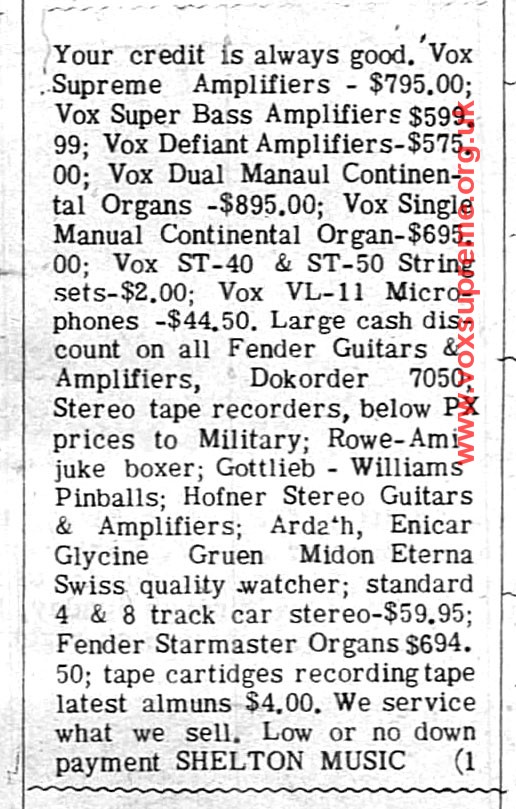
Guam, November 1968.
1st August
It was noted a little while ago that the earliest shop advert to have come to light in the UK for an amp in the new Vox solid state range - for a Conqueror in this case - was from mid June 1967.
It turns out however that Terry Walsh and Bobby Kevin had their Conqueror in mid May, priced at 162 guineas = £170 and 2 shillings, the standard list price. A shot of that advert to follow, below the listing from June.
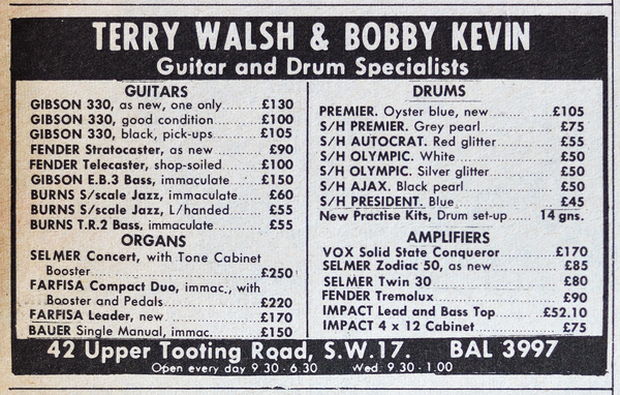
June 1967.
As mentioned in the entry for 27th July, below, JMI's first substantial batches of orders for the new range came at the Frankfurt Musikmesse in late February and early March. Early sales in the UK may have been relatively slow. Adverts in the popular music and trade press only began to pick up in the months leading up to and following the "British Musical Instrument Industries" Trade Fair at the Russell Hotel in August 1967.
Below, JMI's notice of a demonstration of the solid state amps (et al.) in Birmingham in late April 1967, not a shop advert as such, but an event at which orders might be taken from the public and dealers alike. A similar outing for the range had taken place earlier in Liverpool.
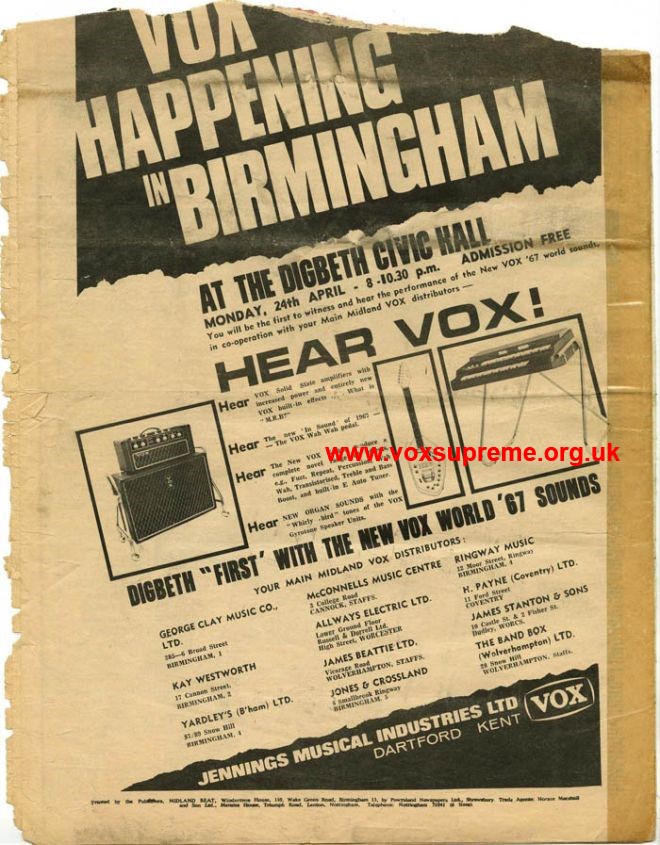
April 1967.
Where Conquerors are concerned, the main stockists in the UK will have been Hessy's in Liverpool; Yardley's in Birmingham; Barratt's in Manchester; Kitchen's in Leeds, and "Musicland" (the Jennings shop in Bexleyheath). Serial numbers 1019 and 1046, along with an amp with a number somewhere in the range 1040-1060, were certainly sold locally. Cooke's in Peterborough, a Jennings dealer from at least 1959, had Dynamic Bass serial number 1063.
Overall, Conquerors and Defiants sold well; Supremes slightly less so. To date no Supreme has come to light with the designation "ST100R" on its serial number plate. Around sixty (each) Conquerors and Defiants had the designation ST30R and ST50R.
31st July
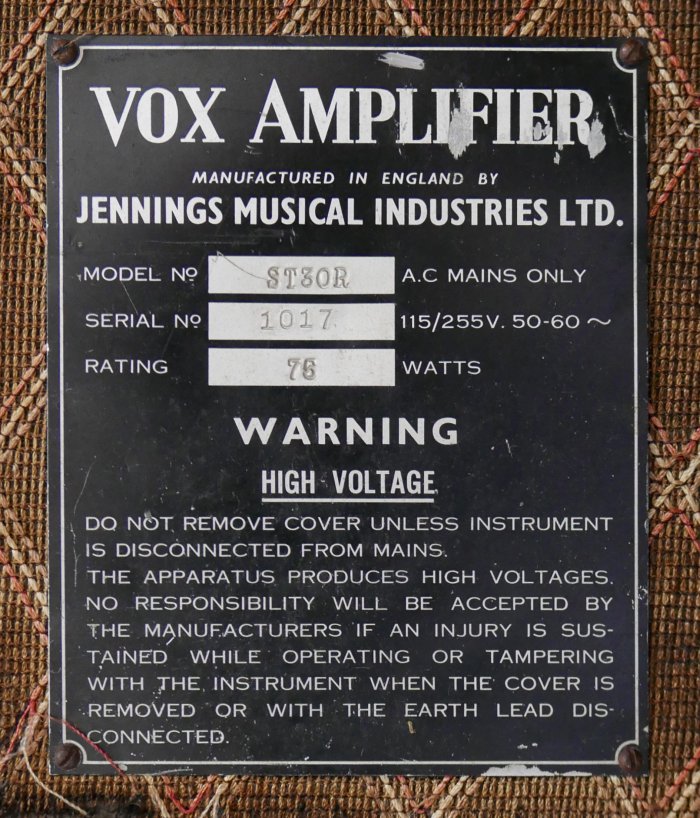
Finally, where Conqueror number 1017 is concerned, some quick shots of its box. The chalk marks / signatures on the inner faces of the ends are now too feint to decipher.
The amp turned up in Holland around 8 years but is currently in the UK. Evidently well used over the years, it is still in full working order.
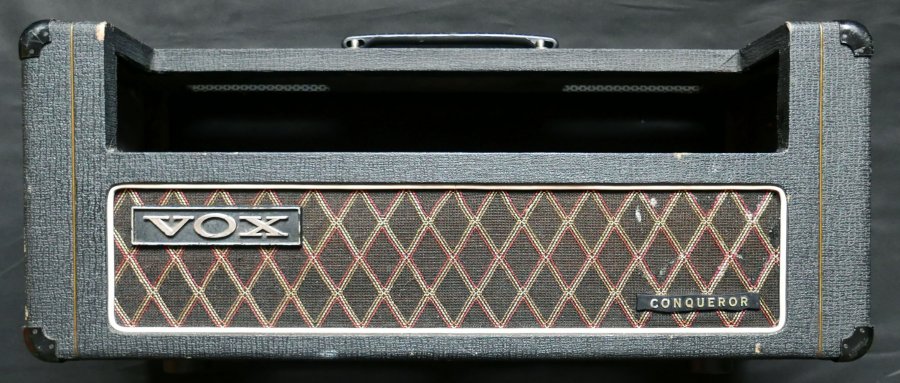
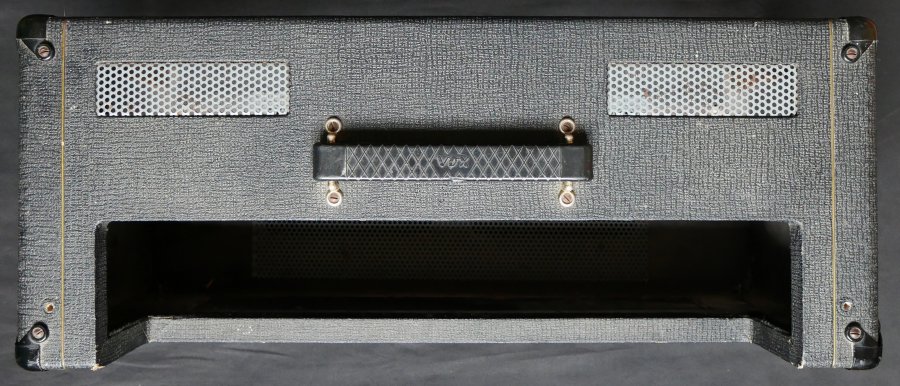
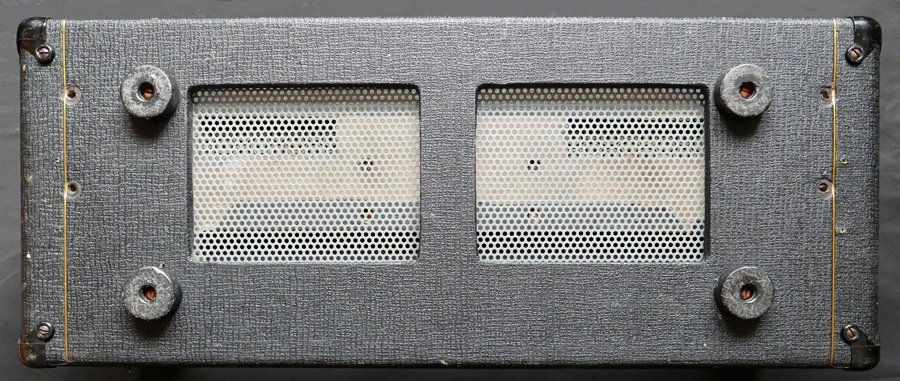
The chrome brackets - part of the means of fixing the amplifier section to the speaker cabinet - were removed by a previous owner.
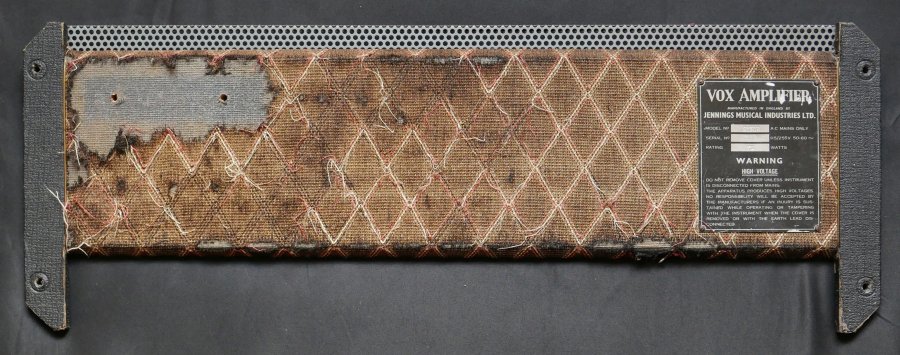
The back panel could do with some new cloth and a logo, but that's for another time.
30th July
The power section of Conqueror number 1017. The latest component date code determinable is on the original RCA 2N3054 transistor: "7A" = January 1967 for its manufacture. The red CCL caps have "K6" = November 1966, and the cement resistors "XL" and "XM" = November and December 1966.
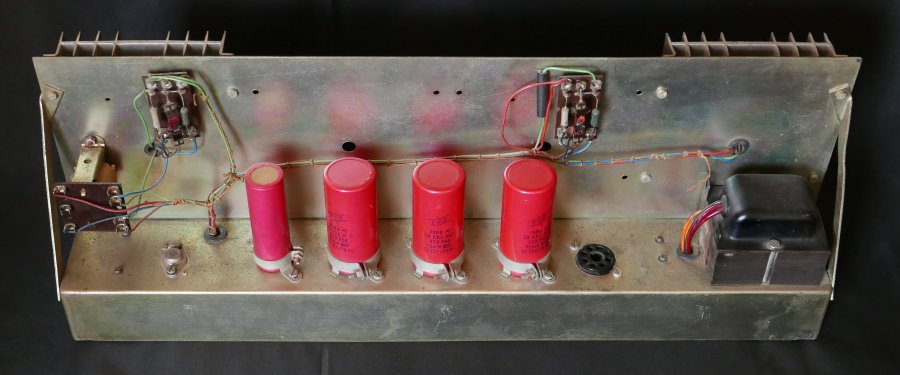
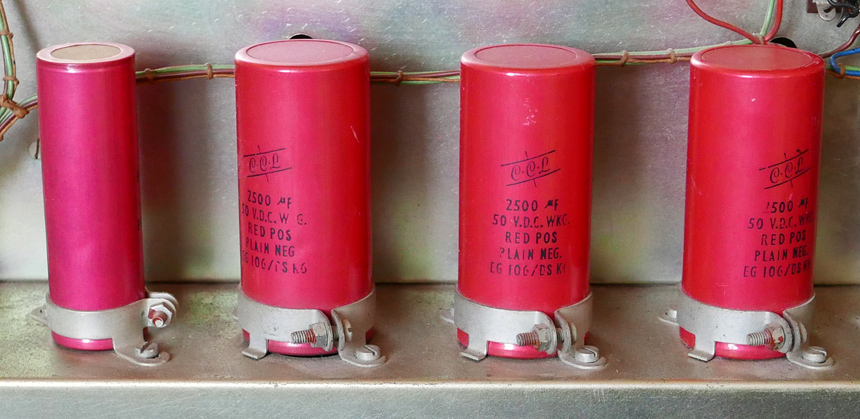
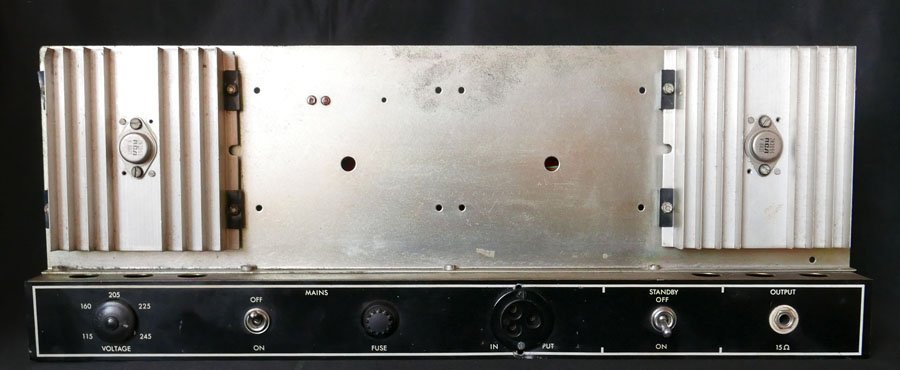
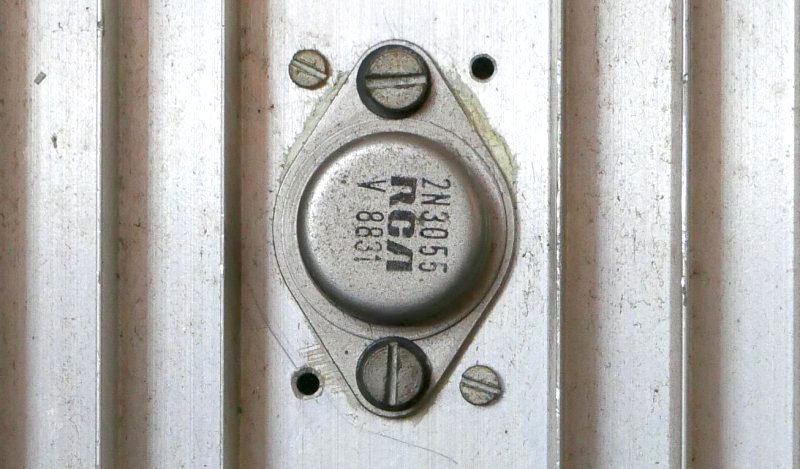
The original power transistors were replaced with a pair of RCAs from 1988.
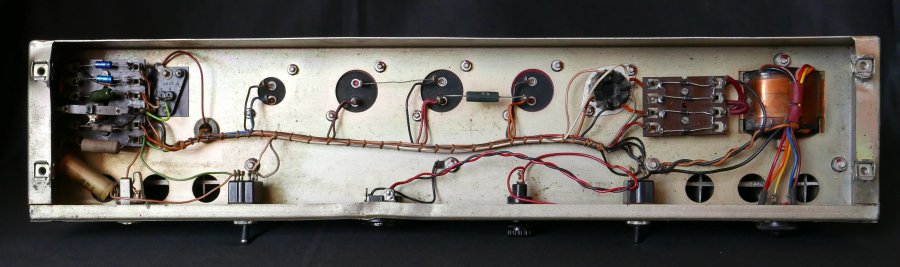
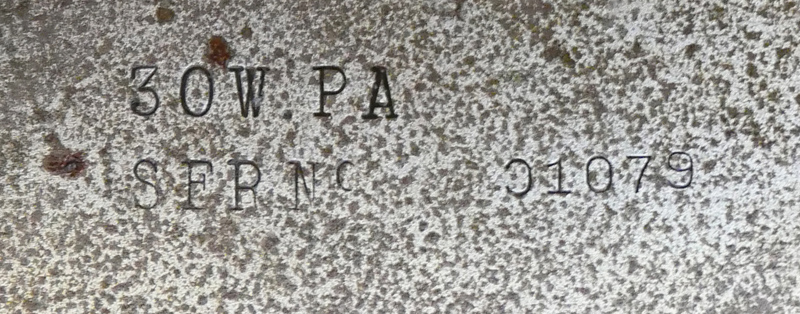
Chassis number 01079. The power chassis of serial number 1046 (pictured in previous entries) is 01071.
29th July
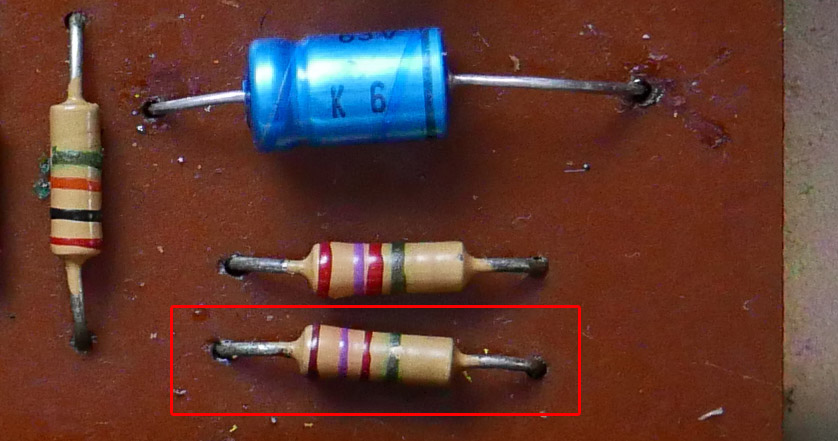
Just to add that the preamp of Conqueror serial number 1017 has an undocumented resistor value on its mixer board - a 1.7K instead of a 2.7K. Possibly a mistake at factory. Currently this is the only definite instance.
28th July
Shots of the preamp of Conqueror (ST30R) serial number 1017. The original yellow Lemco electrolytics, removed some time ago, but retained, had date codes "XL", "XM", and "YB" = November and December 1966, and February 1967. The amp is likely to have been ready for sale in March '67.
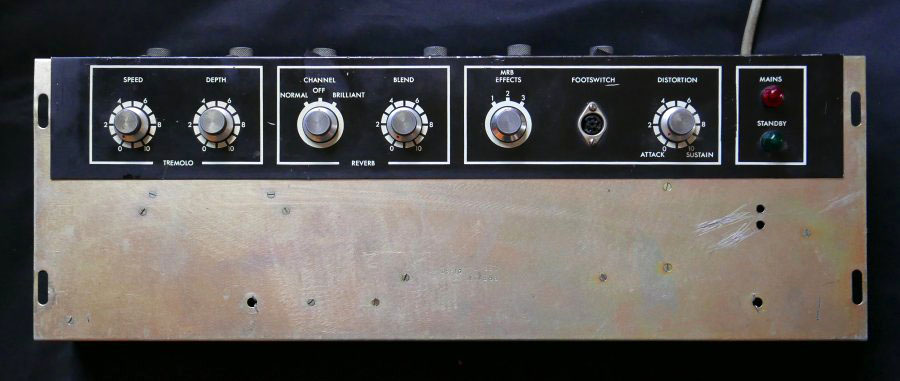
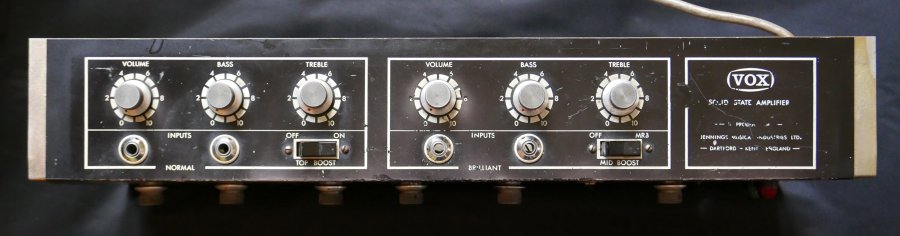
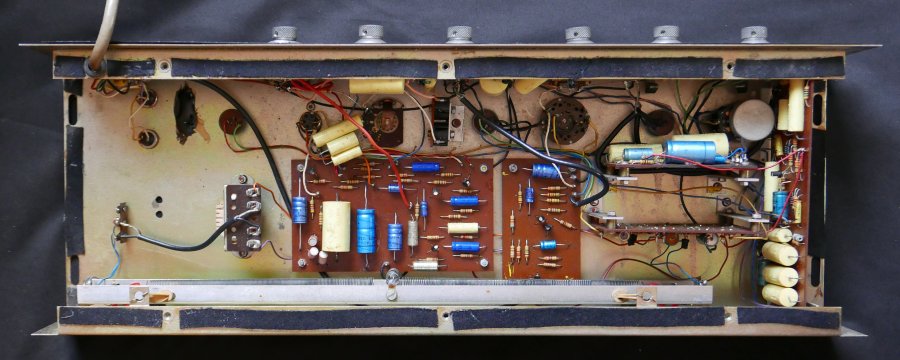
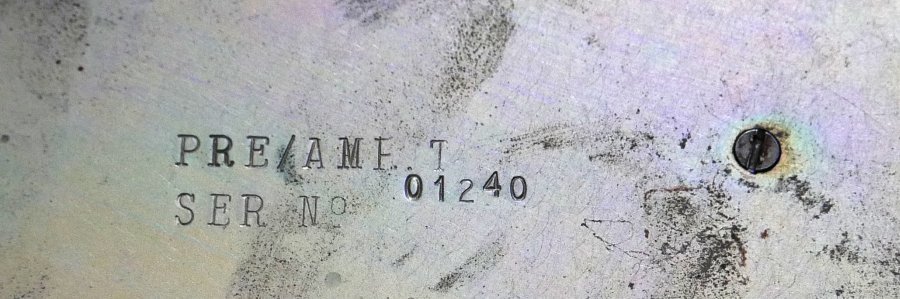
A relatively high chassis number. Treble preamp assemblies were produced in larger numbers than Conqueror/Dynamic Bass power chassis as they served not only the Conqueror, but the Virtuoso, Defiant and Supreme too. Some will have been kept back as spares or for repairs.
27th July
The principal unveiling of what was to become the standard production Vox solid state line took place at the Frankfurt Musikmesse, 26th February to 2nd March, 1967. Reg Clarke, JMI's General Sales Manager, noted: "For months now dealers have been begging us to accept orders. ... We are not playing hard to get. It is just that we agreed to make sure that everybody from all over the world gets the same chance to see and order a line." This was seconded by Tom.
Northern European dealers were evidently not slow to put their requests in. Below, two of the earliest known Conquerors, likely to have been exported early on - serial number 1009 (Northern Germany), and serial number 1017 (originally Holland, now in the UK).
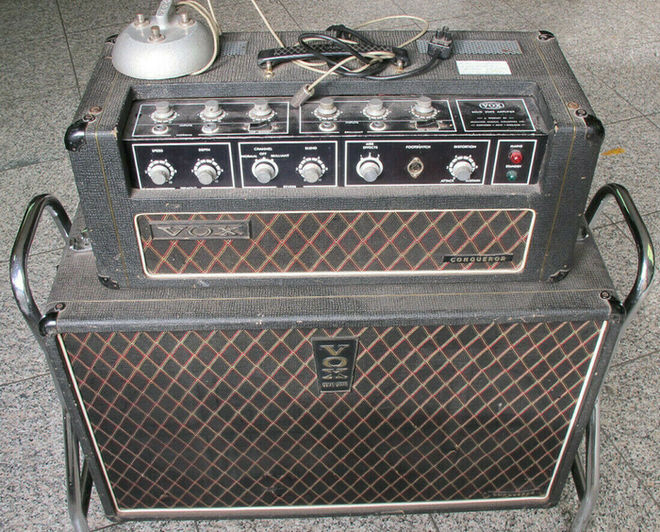
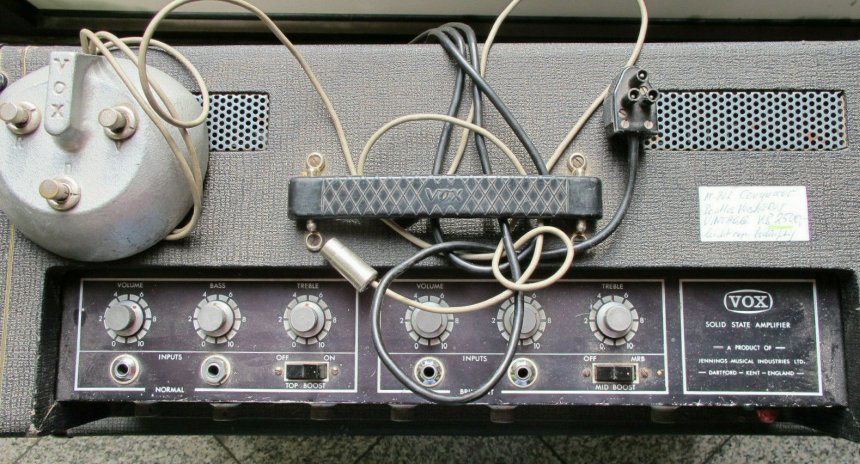
Above, Conqueror (ST30R) serial number 1009.
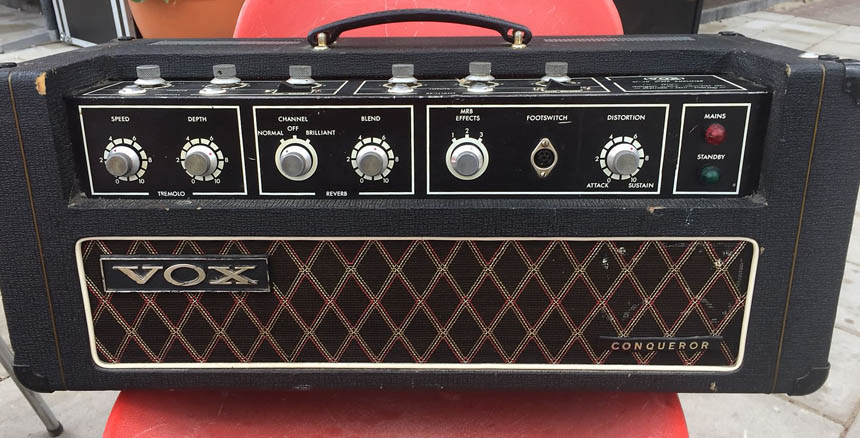
Conqueror (ST30R) serial number 1017. Some new pictures to come soon.
The earliest Dynamic Bass sets currently known are in Europe too: one in Belgium, the other in Holland.
25th July
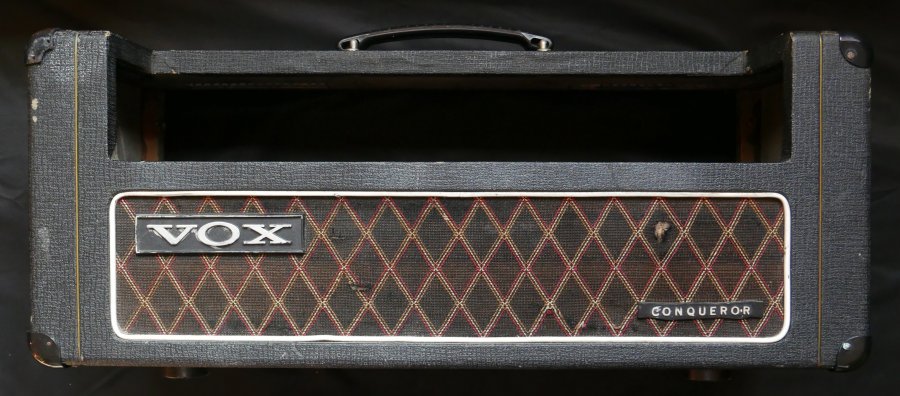
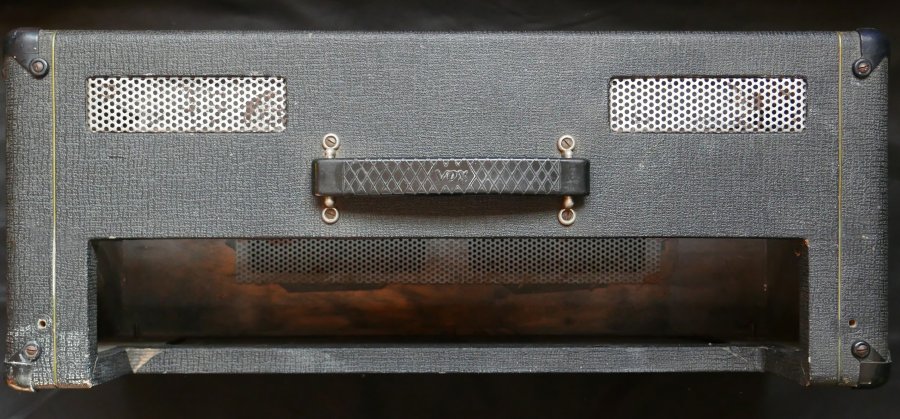
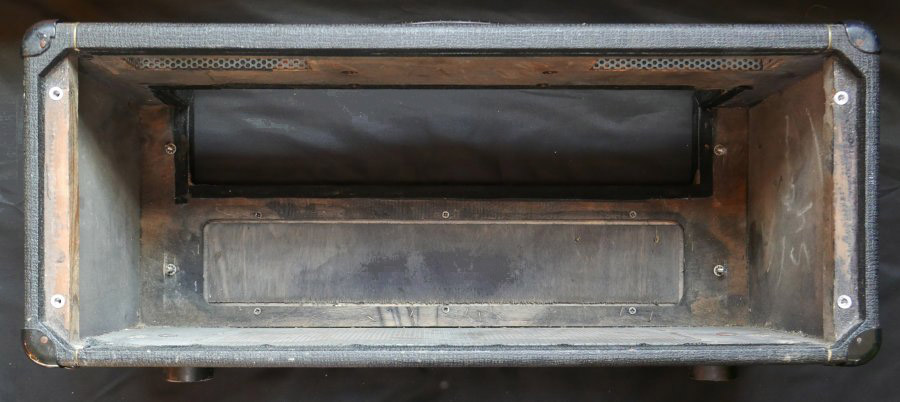
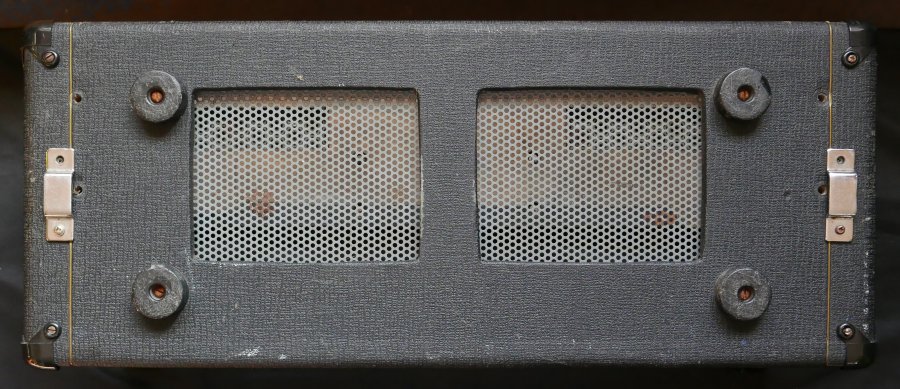
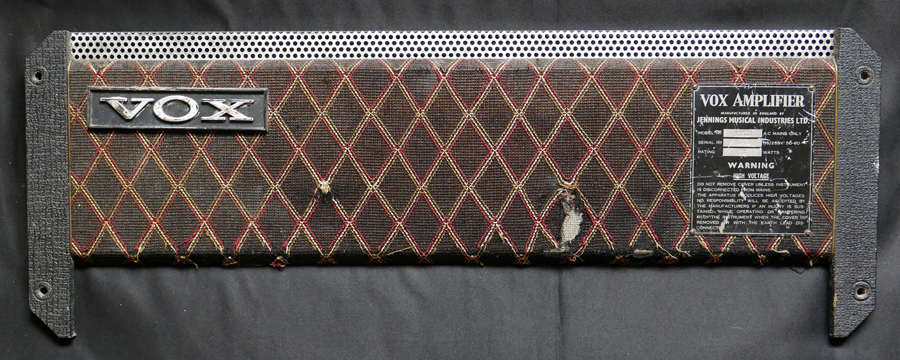
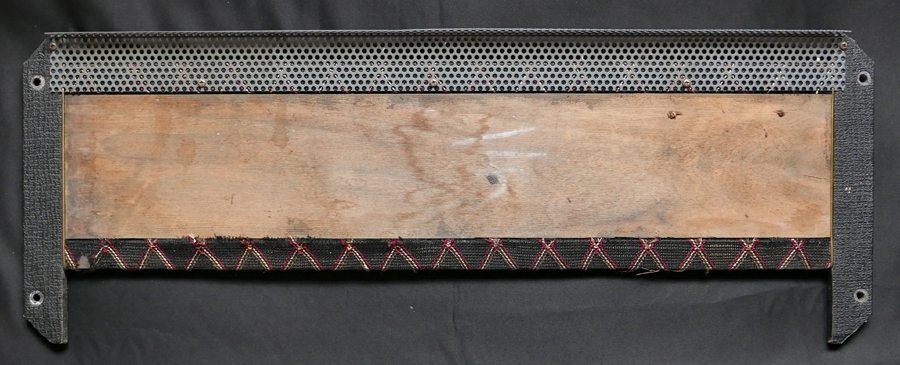
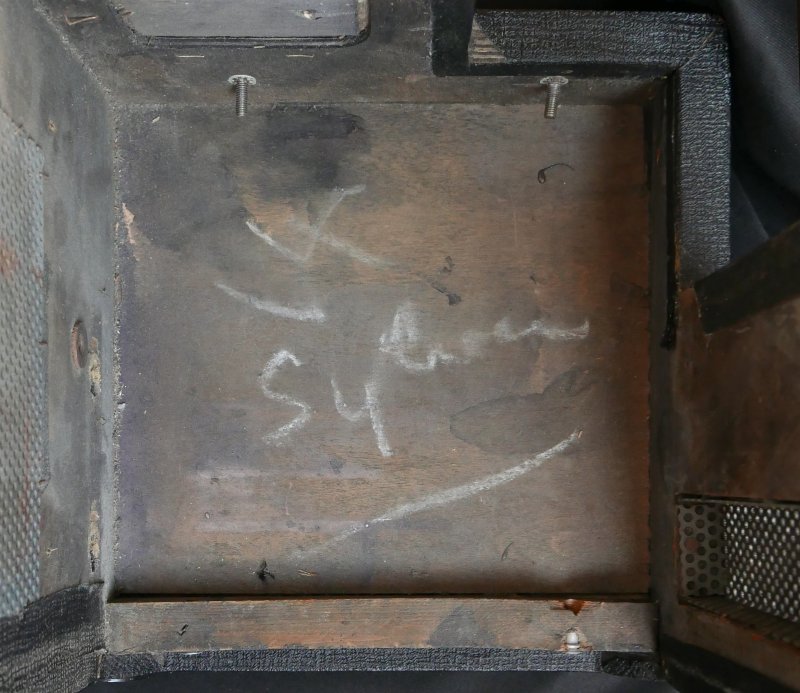
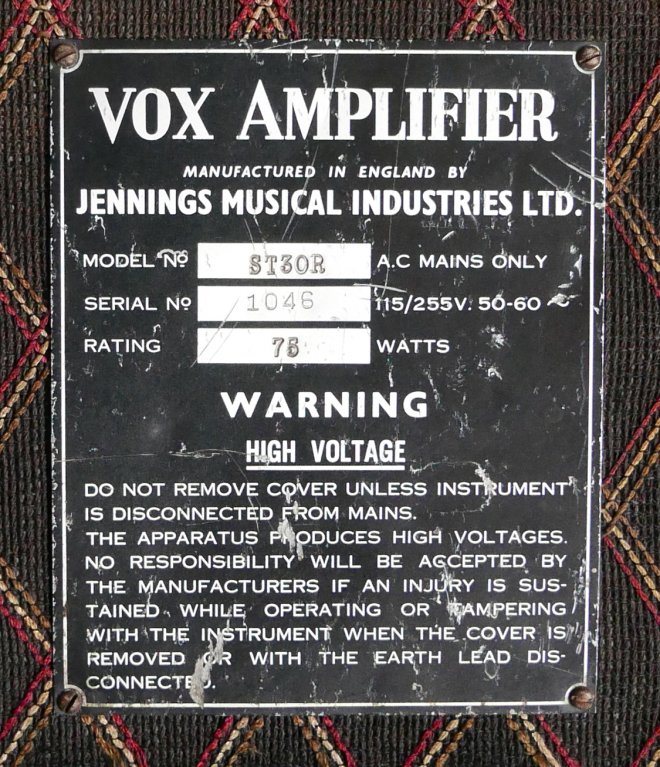
The box of Conqueror 1046, numbered "14" in chalk (both body of the case and back panel), the fitting out - the adding of the grille cloth, handle, logos, etc. - done by Sylvia. Condition is generally good. The chrome brackets (for attaching the cabinet to the speaker cabinet) survive on the underside.
Dimensions: 23 3/4" x 9 1/2" x 9 1/2".
23rd July
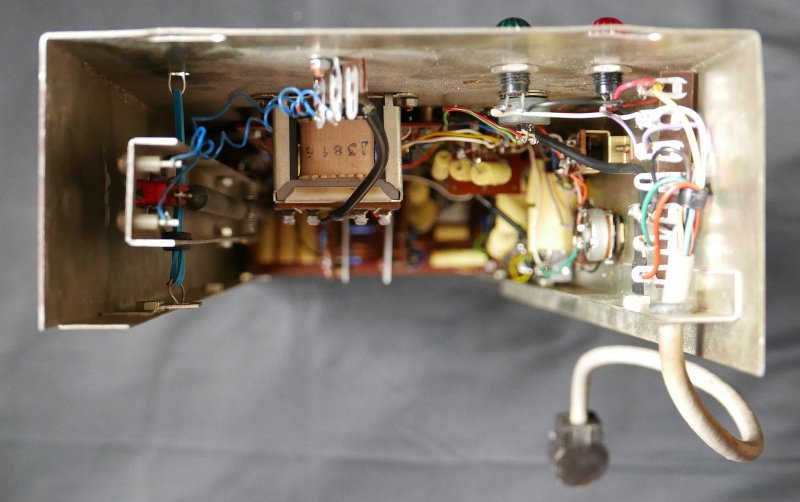
The preamp assembly of Conqueror serial number 1046, in full working order following recapping around 15 years ago, the correct lenses returned to the indicator lamps. Chassis number 01045.
It measures: 21" x 7 1/4" x 3 5/8" (control panel depth). The depth of the bottom of the assembly is 3".
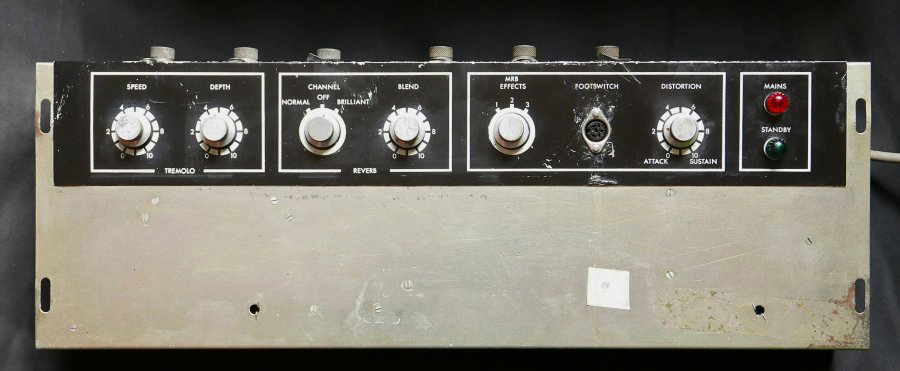

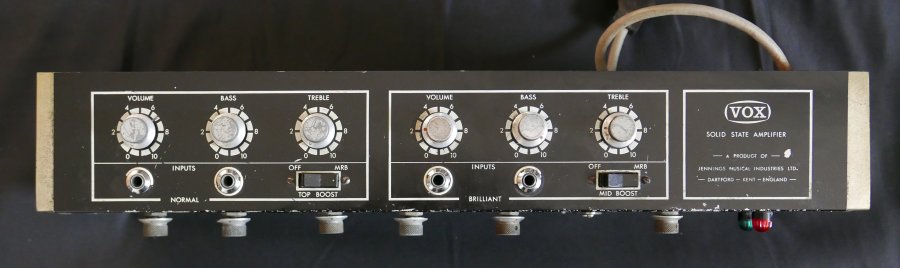
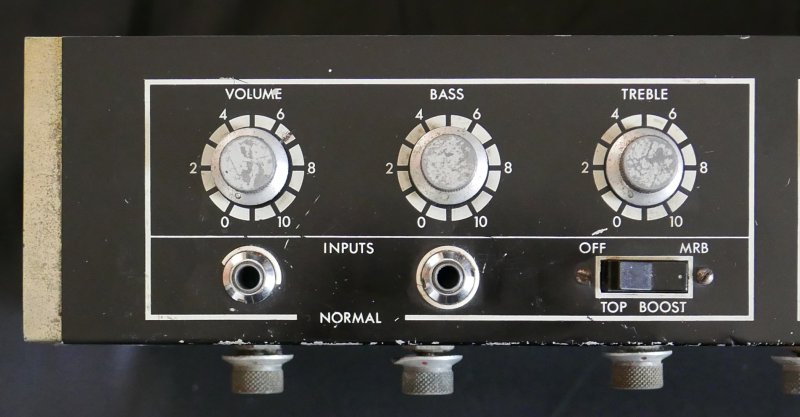
The misprinted panel. The Top Boost switch has "OFF" / "MRB" instead of "OFF" / "ON". Six amps are currently known with this type of panel.
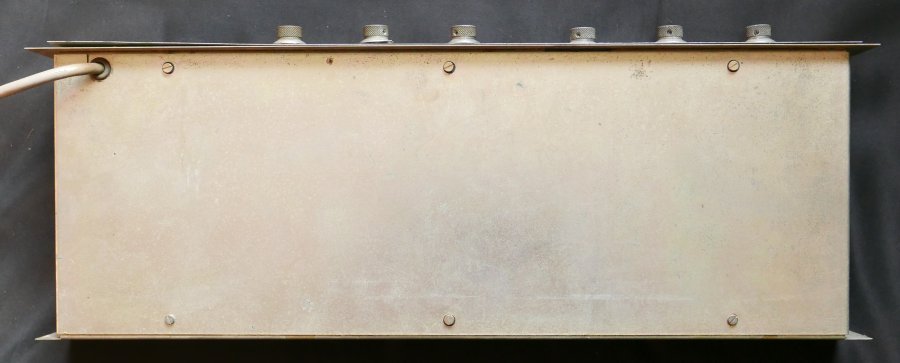
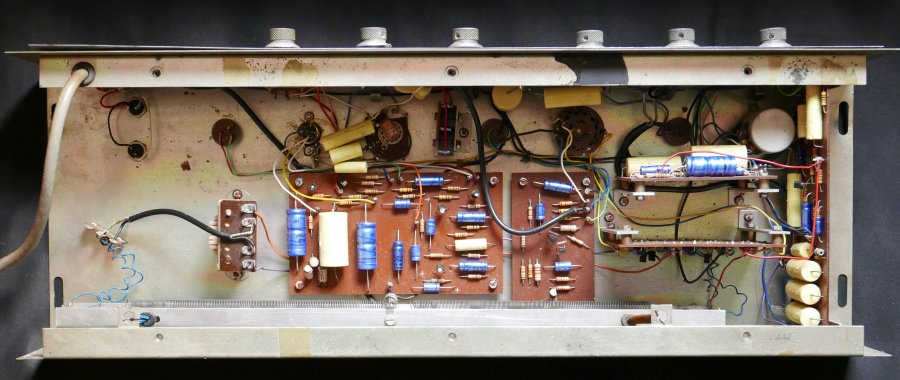
The original small-value yellow Lemco electrolytic capacitors (date codes in late 1966) had completely dried out. The preamp would barely make a sound before recapping.
22nd July
Some recent shots of the power section of Conqueror (ST30R = Super Twin 30 Reverb) serial number 1046, still in good working order, only a couple of replaced components. The chassis number is 01071, the latest dated component "A7" = January 1967. In common with other early chassis, there are no side struts to support the upright, which makes for a slight floppiness in the assembly when out of its cabinet.
The plinths of Conqueror chassis measure: 21" x 4 1/2" x 2"; those of Defiants and Supremes: 21" x 5 3/4" x 2".
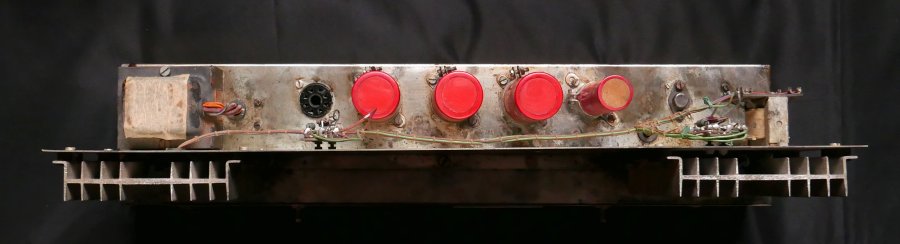
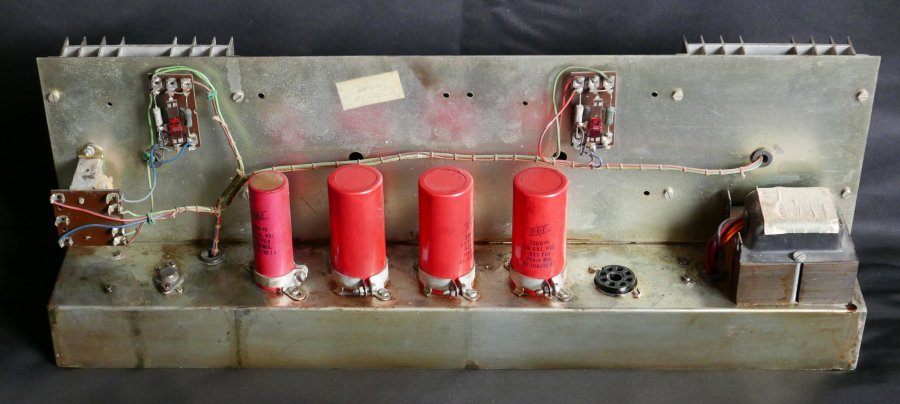
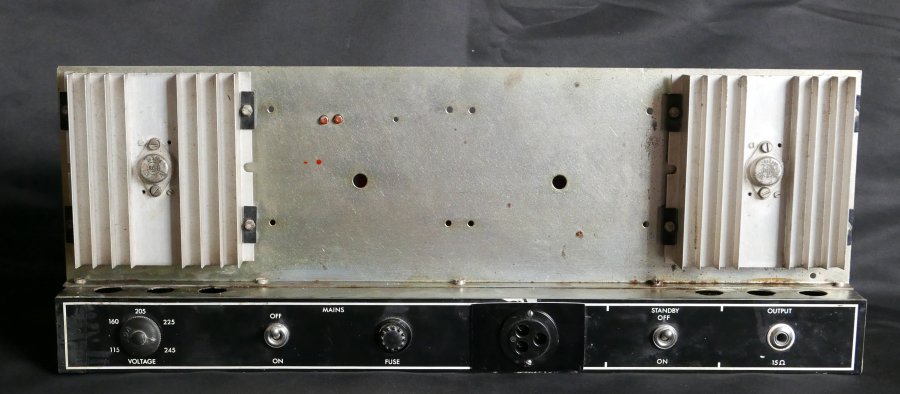
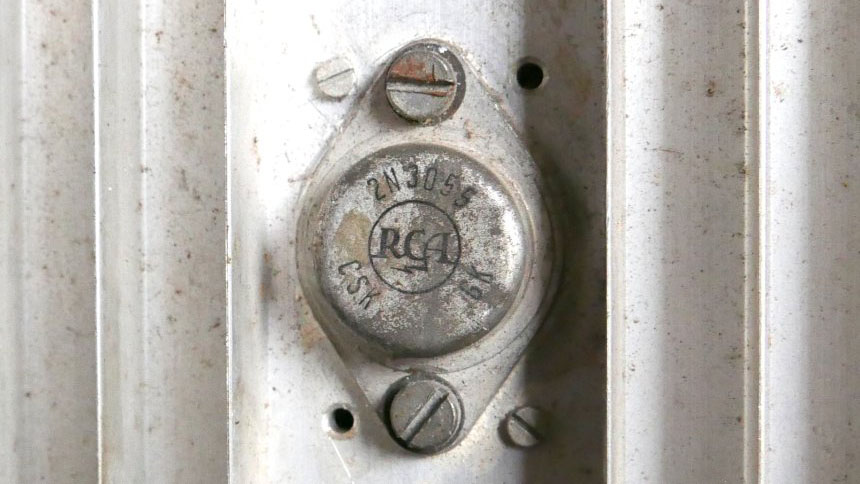
RCA 2N3055 dated "6K" = October 1966.
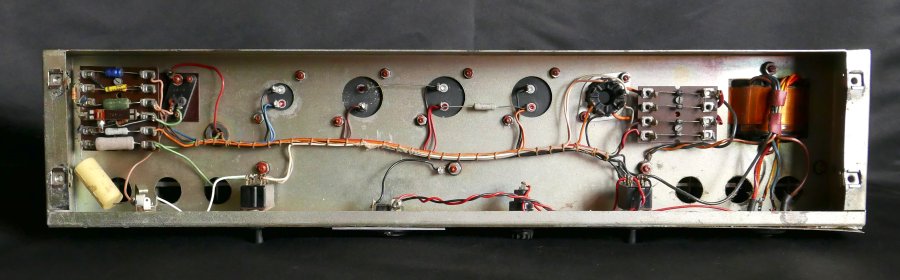
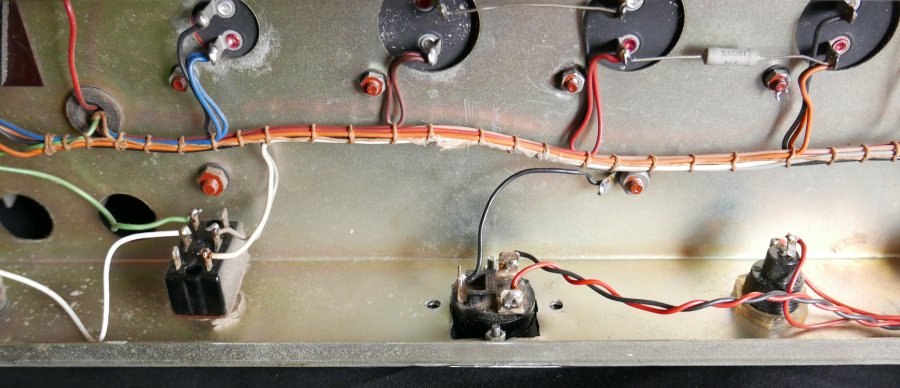
The power socket was rather crudely replaced in 1991. A Belling Lee is now back in place with a traffolyte panel to support it.
21st July
A note on the circuit diagrams for the solid state range that are described in terms of power output rather than model name (see the entry below, 14th July). The versions currently known in hard copy are:
OS/131: - "10 Watt Solid State Amplifier". No dates.
OS/132: - "15 Watt Solid State Amplifier (Power Stage)". No dates.
OS/133: - "30 Watt Solid State Amplifier - Power Stage -". Date unknown.
OS/134: - "50 Watt Solid State Amplifier - Power Stage -". Dated 28.11.66, one change 1.2.67.
OS/135: - "100 Watt Solid State Amplifier - Power Stage -". Undated.
OS/136: - "15-100W Solid State Amplifier - Pre-amp Stage - Treble with Reverb". The original print of the sheet contains the addition "MK II" to the right of the title. Dated 1.11.66, with three changes through to 31.3.67.
OS/137: - "30-100W Solid State Amplifier - Pre-amp Stage - Bass". Dated 1.11.66, with three changes through to 31.3.67.
The latest date noted on the Power Stage sheets is February 1967, the latest in relation to the Preamps the end of March 1967, the latter coinciding with the sending out of the first standard production sets.
Why no model names initially? Presumably, on a fairly general level, simply to factor in scope for change. The Conqueror of course had been named at least as far back as August 1966; the Virtuoso/Supreme not until February 1967. The note of the change is illustrated below, entry for 14th July. All that was required for the amplifiers themselves once production had begun was (i) a moulded runner bearing the model name (for the front grille); and (ii) the relevant printed documentation (catalogue and pricelist entries, warranty cards, etc). Serial number plates were stamped as needed.
Just to note though that the Conqueror shown in August 1966 already had its name on runners on both amplifier section and speaker cabinet.
Whether there was any intention initially to produce a full range of solid state PA amplifiers along the lines of the valve-driven Metal Clads - a PA15SS, PA30SS, PA50SS and PA100SS to replace the MC15, MC30, MC50 and MC100 - is unclear at present. The only amps mentioned in existing promotional literature are the PA50SS and PA100SS, both of which had a fairly bumpy ride to market.
20th July
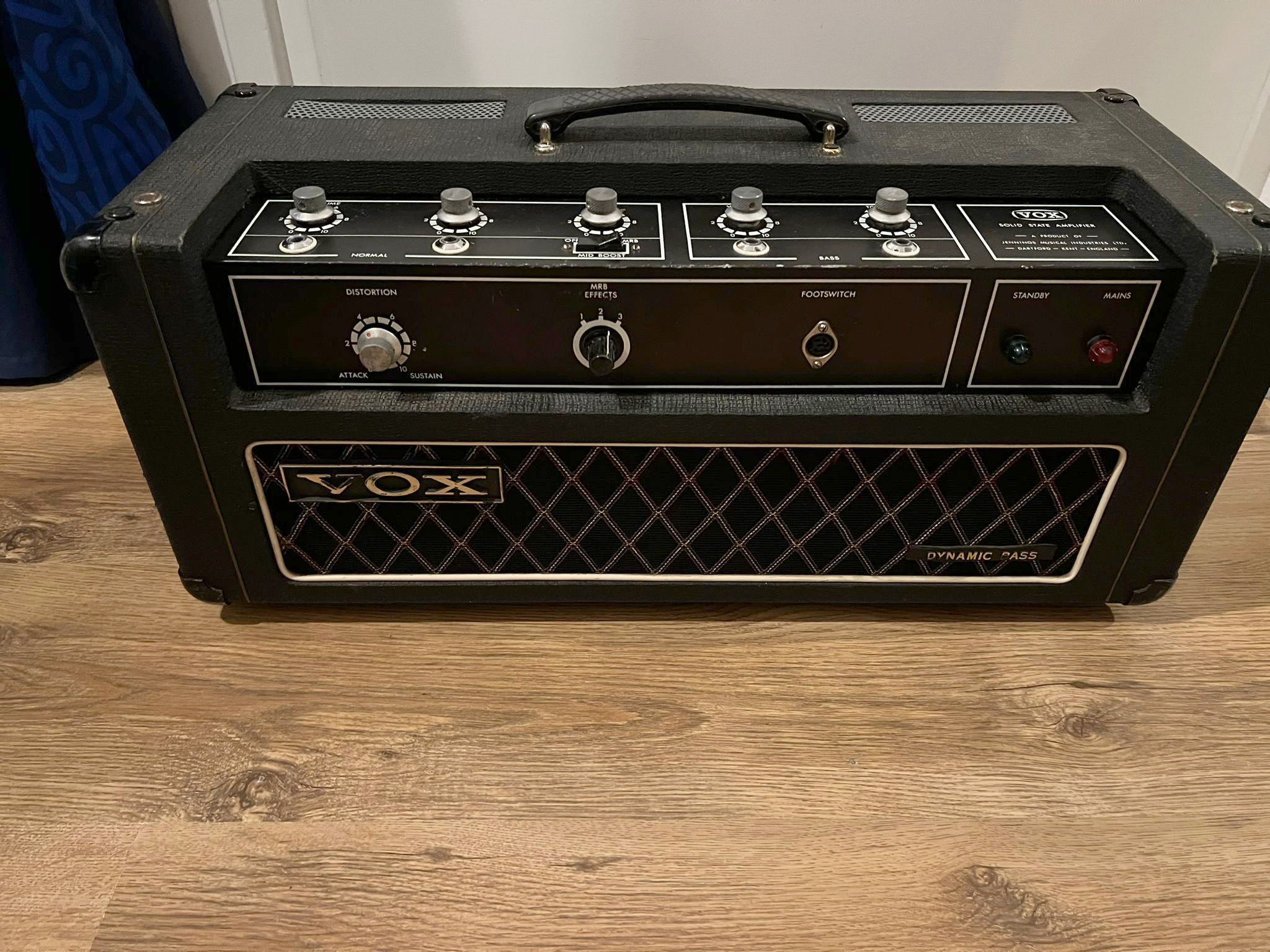
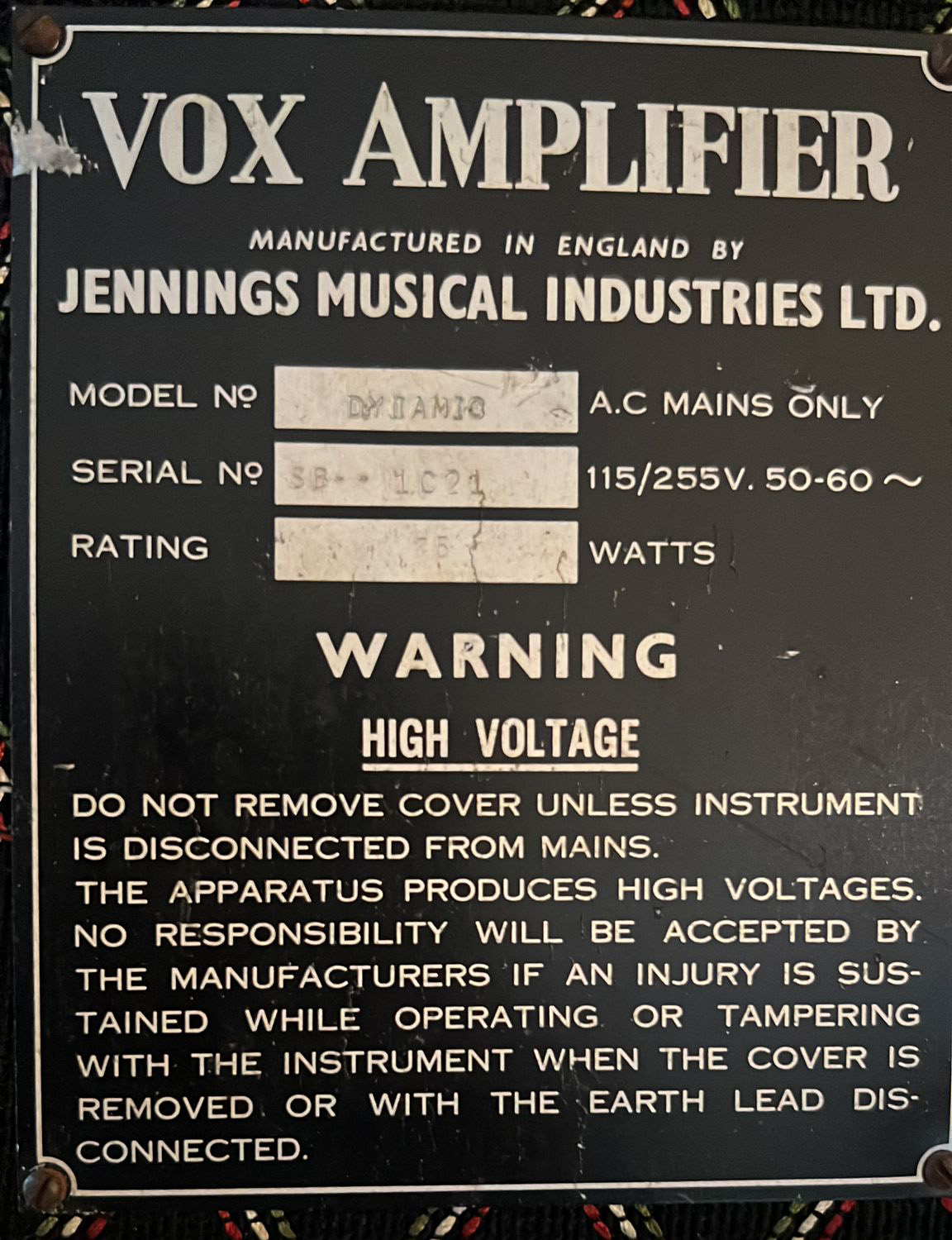
Thanks to Dave, pictures of a superb early Vox Dynamic Bass - serial number 1021 - have been added on this page.
15th July
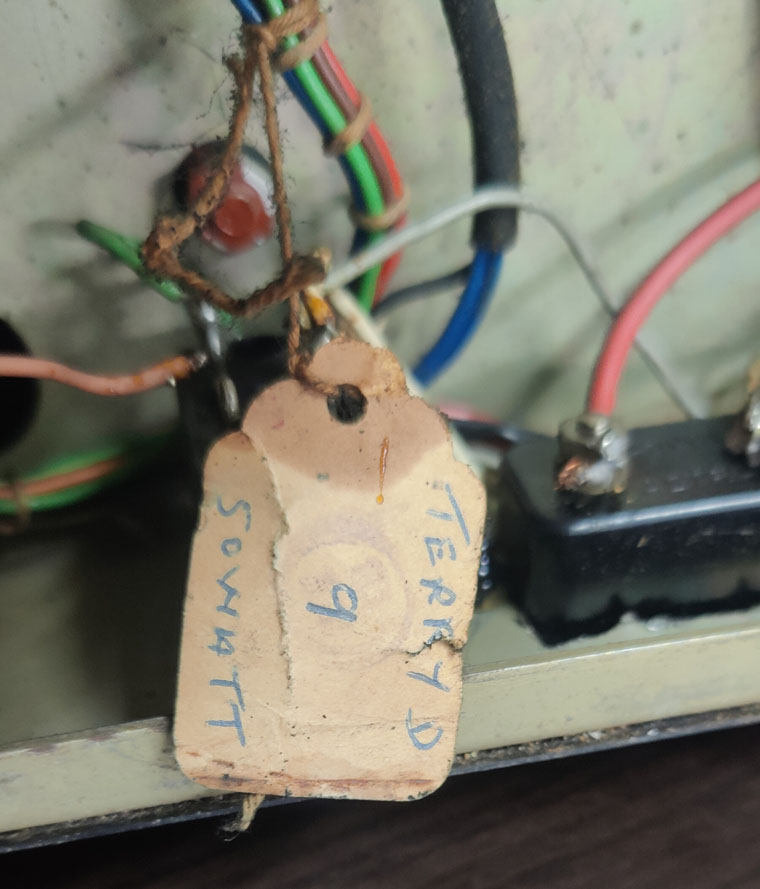
Thanks to Miguel, a great shot of the Burndept inspection tag for the power section of Foundation Bass serial number 1548, signed off by "Terry D".
14th July
A couple of circuit diagrams not much circulated by JMI: one for The Traveller (termed "10 Watt Solid State Amplifier"); the other for the power section of what was to become The Virtuoso (termed "15 Watt Solid State Amplifier"). Neither is dated or has a register of changes.
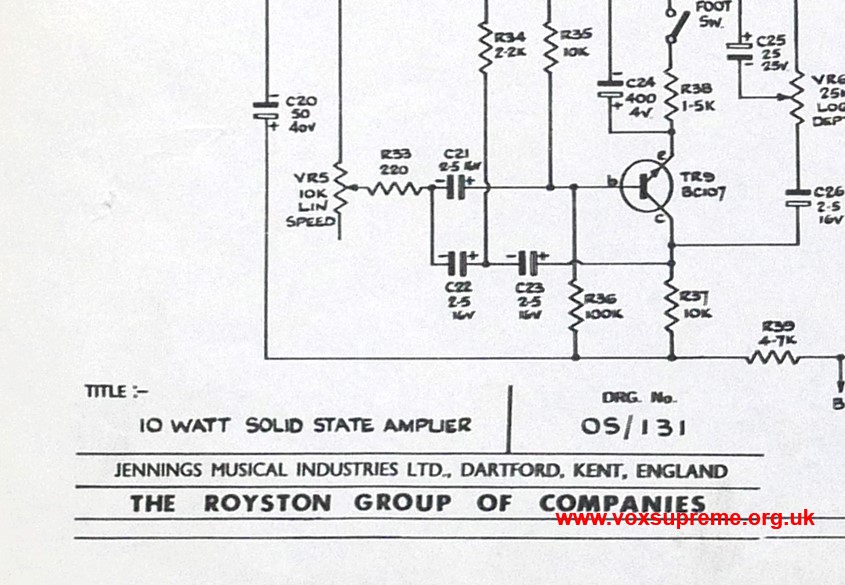
OS/131 for the 10 Watt Amplifier. Other versions give the name of the model as "The Traveller".
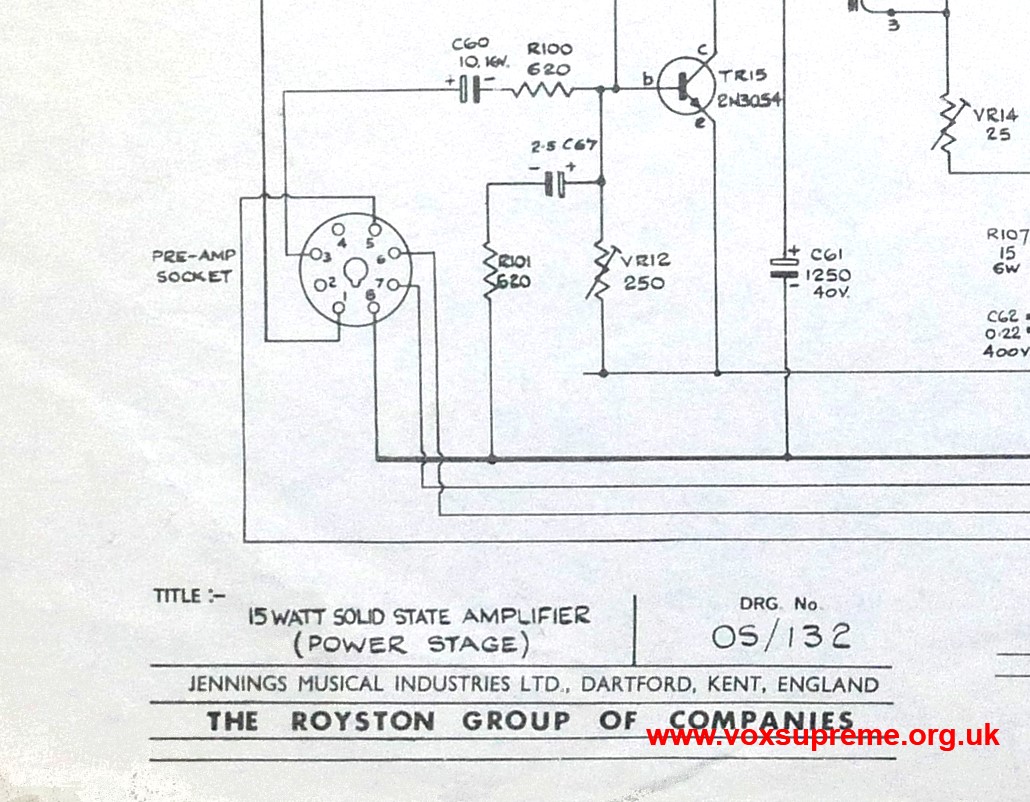
OS/132 for the 15 Watt Amplifier. Other versions give the name of the model as "The Virtuoso".
As has long been known, the 15 Watt Amplifier was originally known as the "Supreme", the change to "Virtuoso" taking place in February 1967.

Detail from the most common version of OS/132. "VIRTUOSO WAS SUPREME".
The other sheets that do not give a model name - i.e. simply a statement of power output - generally overlap with the mainstream diagrams in terms of date: e.g. the versions for the power section of the "100W Solid State Amplifier" and the Supreme and Super Foundation Bass both have "25.11.66" as a starting point, aligning with the date of the Burndept build sheets (for standard production).
10th July
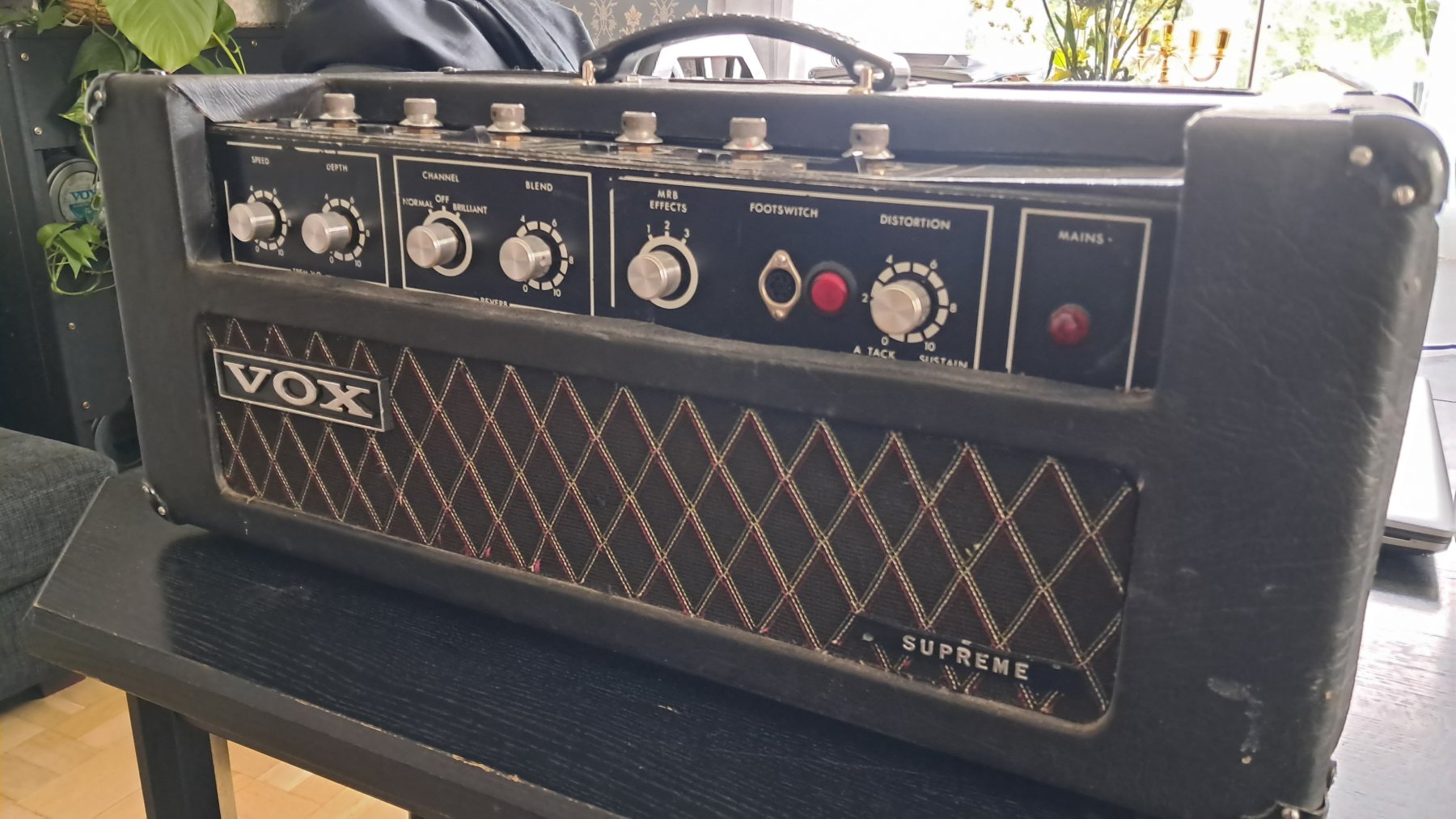
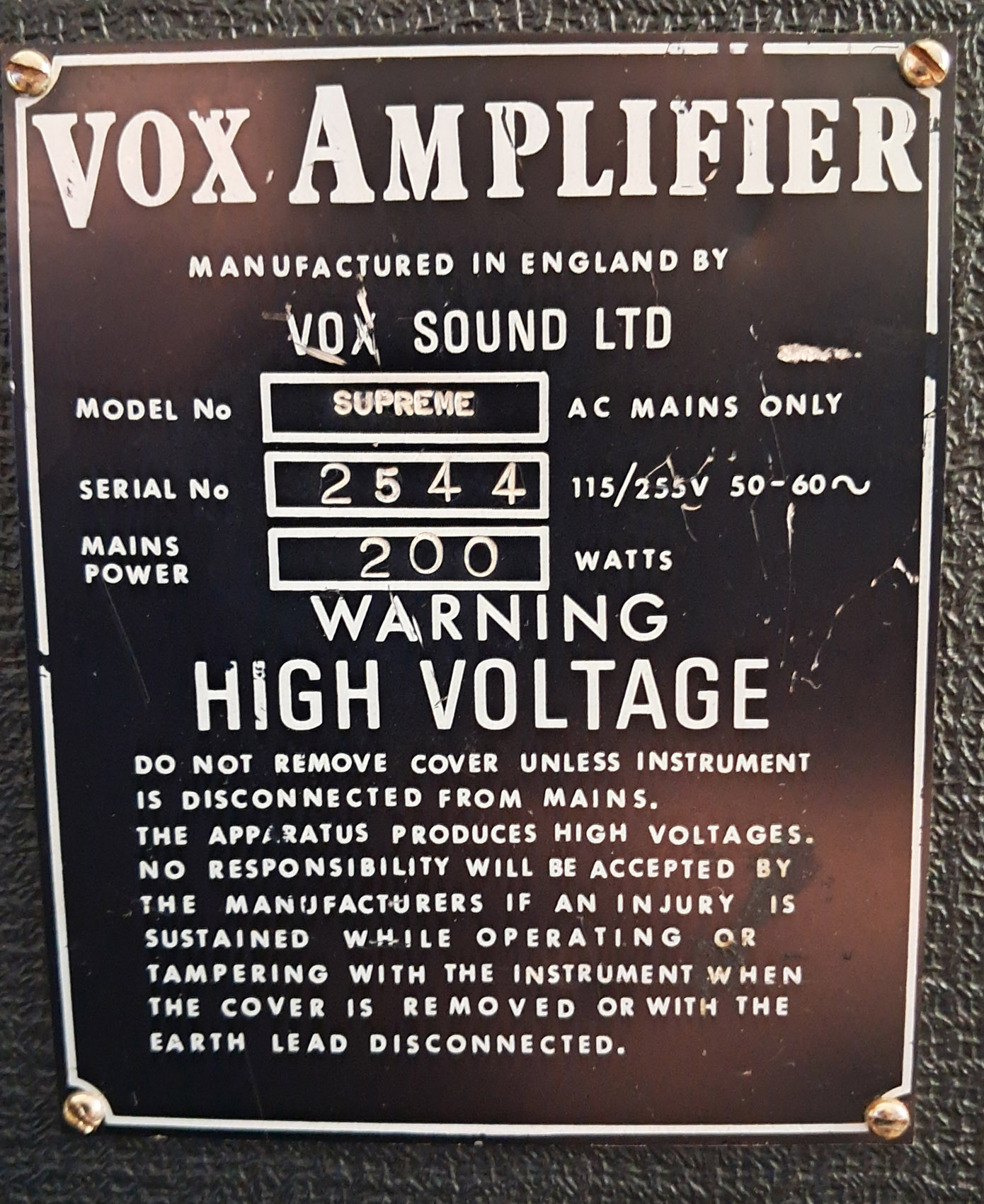
Thanks to Björn, a couple of shots of VSL Supreme serial number 2544, probably later 1972, have been added to this page.
7th July
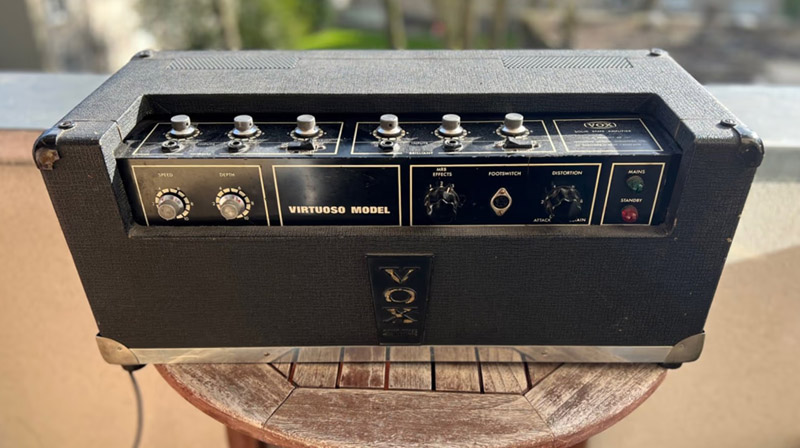
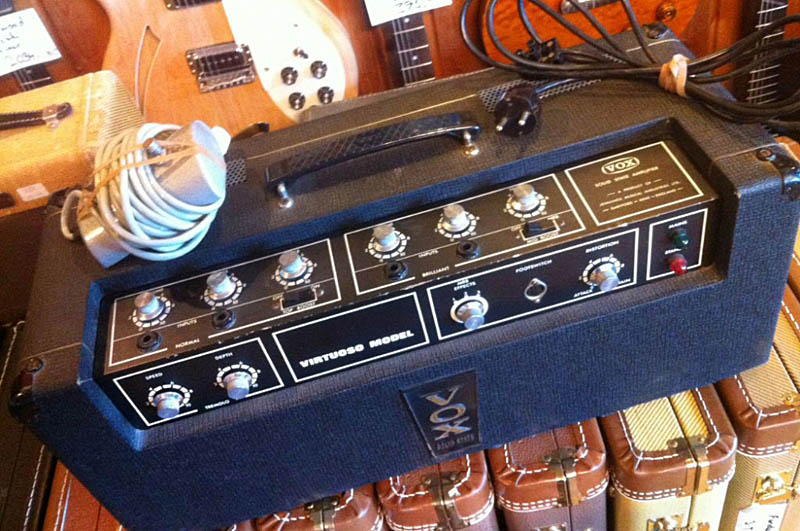
A couple more decapitated Virtuosos, the second fairly skilfully done as these things go. Five in total are currently known.
6th July
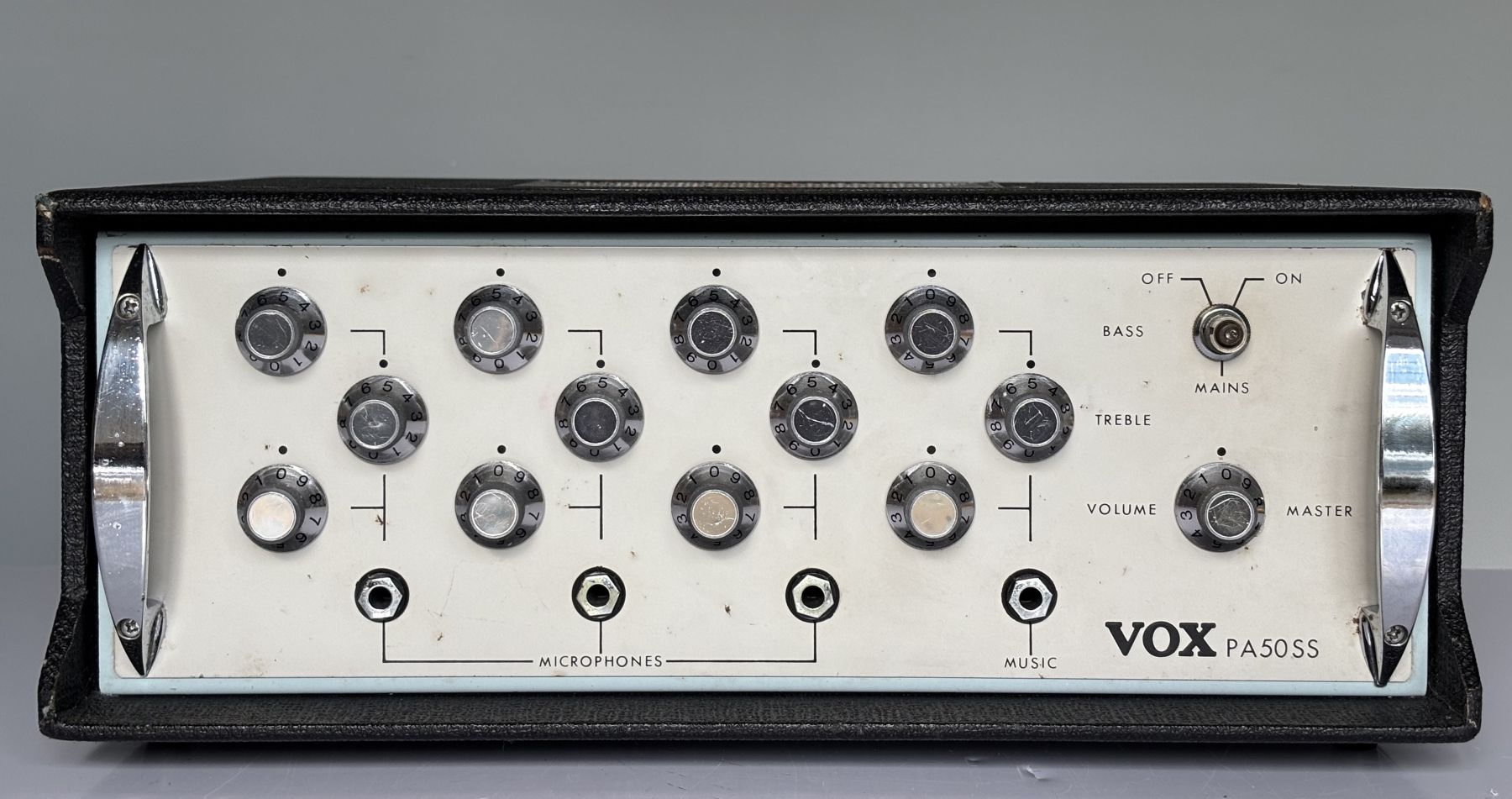
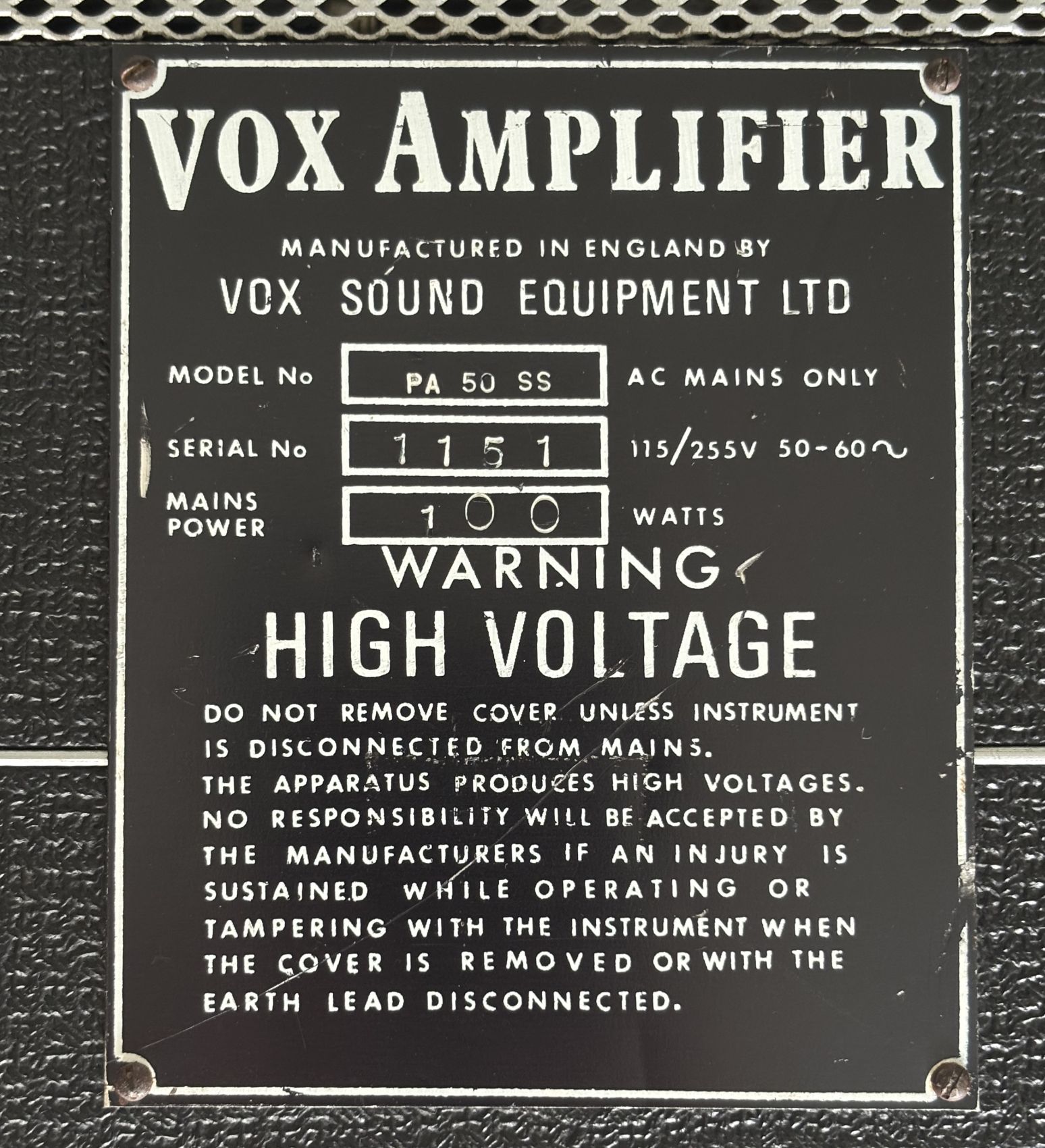
Thanks to Mark, details of Vox PA50SS serial number 1151 from later 1969 can now be seen on this page.

4th July
As mentioned in yesterday's entry, pre-production solid state amps were fitted out by JMI with American-made Amphenol mains sockets - an unusual choice. Standard production amps, starting from November 1966, had English-made Belling Lees. Below, a detail from the Burndept components sheet for the Supreme and Super Foundation Bass.
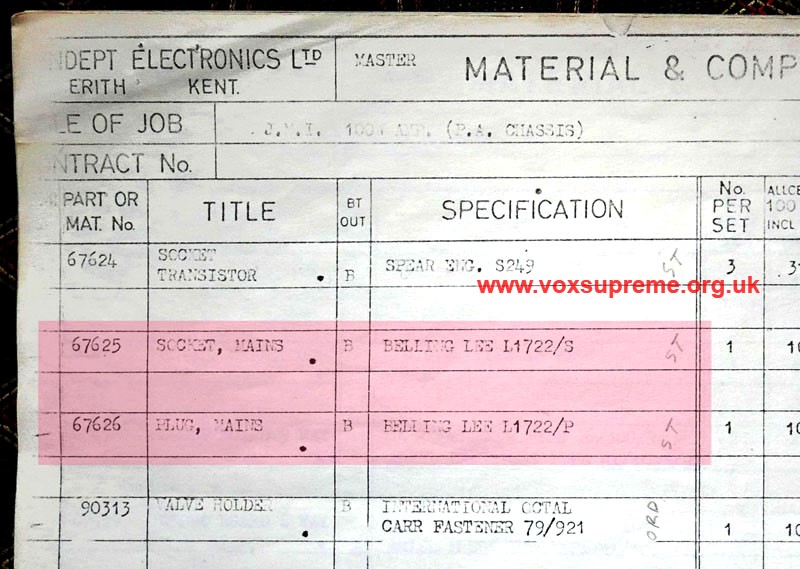
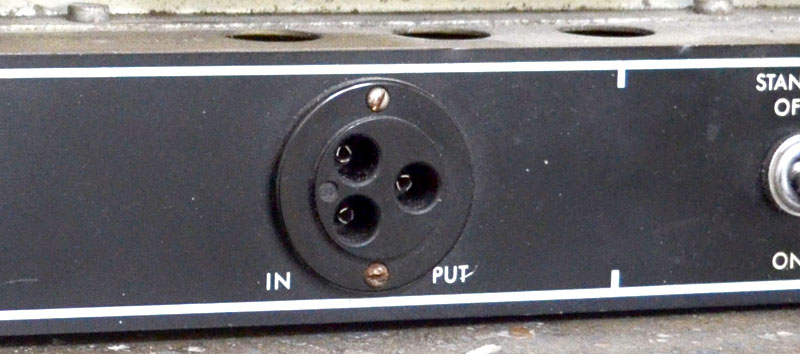
A Belling Lee L1722/S in place.
3rd July
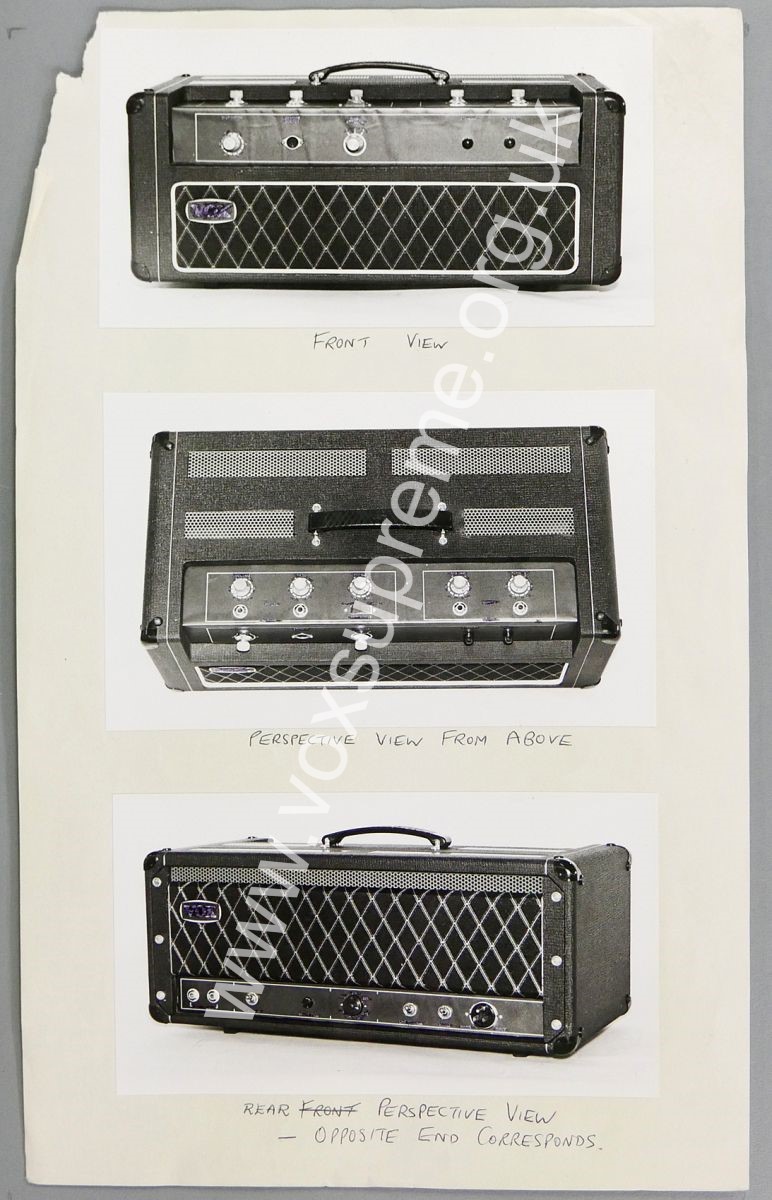
Photographs of the solid state amplifiers submitted by JMI to the Patent Office on 27th July 1966. Seven survive: four for a Defiant/Supreme amplifier section, three for a Foundation/Super Foundation Bass. Legends and logo, which formed no part of the submission, were struck through in blue. The pictures will naturally have been taken earlier in July.
Design was already well advanced. The control panels of the two versions (bass and treble) were on printed sheets of some sort though - i.e. designed but not printed on metal. Although it is not known for certain at present whether solid state bass amps were displayed at the London Trade Fair in late August 1966 along with the Conqueror and Supreme, the pictures below do suggest so.
One of the (many) peculiar things about the pre-production amps is the presence of an American Amphenol mains sockets of a type not used before by JMI. Plugs to fit will have been extremely uncommon in electrical shops in the UK in the 1960s. Stock was presumably available to JMI via the Amphenol factory down the coast at Whitstable.
Was the intention originally to release the range to coincide with the Thomas amplifiers (shown for the first time in late June / early July 1966)? A few months later the two companies certainly synchronised their advertising and release of the Wah-Wah pedal.
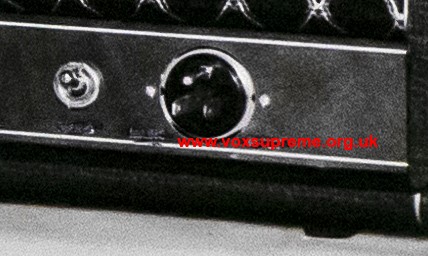
Detail of the Amphenol socket.
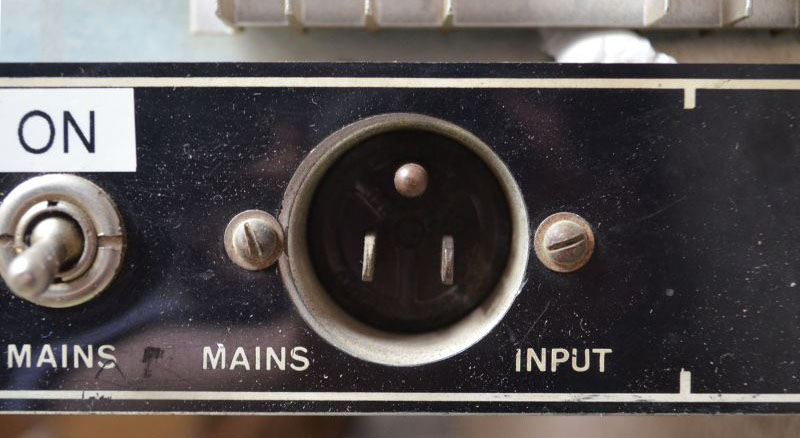
Amphenol socket on a pre-production Defiant. It is extremely hard these days to find plugs to match. The US standard changed at some point in the 1980s. Later plugs that at first glance look the same do not fit.
2nd July
There is now a page on the speaker cabinet of Vox Defiant serial number 1451.
1st July
A synopsis of sections D, E, and F of the Warwick Industries report of Dick Denney's visit to Sepulveda in October 1965 published in "The Vox Story", ed. Denney and Petersen (1993), pp. 141-145. Copies of "The Vox Story" are still relatively easy to come by - well worth buying or borrowing.
1: - three transistor amplifiers are expressly mentioned: "engineering protoypes" of proposed 30W and 100W models, the latter already termed the "Super Beatle"; and a production example of the "Essex Bass".
2: - the 30W and 100W prototypes evidently had at least two channels - Normal and Brilliant - perhaps Bass too though nothing is said explicitly. Denney is reported as having found the tremolo (on the Normal Channel) "very good".
4: - the 100W version was tested with a bass guitar, and an unpleasant sound noted at volume. During Denney's visit, a limiting circuit (an existing but unused Thomas design) was added.
5: - no explicit mention is made either of reverb or distortion.
6: - Denney is said to have approved of the modular design of the proposed range - front end the same, but varying power chassis of different outputs.
7: - following discussion, it was felt that the Essex Bass might benefit from the limiter too.
8: - the Essex Bass had the Tone-X circuit (which Sava Jacobsen later indicated was of his own design).
9: - the paragraph on the tone circuits of the 30W and 100W engineering prototypes begins with a sentence noting that they were judged to be "satisfactory". Some of the statements that follow are a little difficult to construe in places though. It may be that a number of the elements presented for assessment were on independent boards (separate assemblies) that could be connected and disconnected for testing and review. The report states:
"The resonant boost feature may represent a new sound in guitar amplifiers and can be carried to any degree of variety by providing multiple switch positions. Warwick proposes, at this time, to include at least one such selection on a boost switch in the treble channel and will also reserve provision for, perhaps, a three-position selector switch on the rear panel.... An interesting wah-wah effect is obtained by operating the boost switch between its two positions.
The first sentence is certainly a statement of Thomas's feeling. The extent to which it reflected, or was derived from, Denney's views and suggestions not clear.
10: - little is said of the power sections of the 30W and 100W prototypes. Both were designed for a 2 ohm speaker load. Dick recommended four Celestion T1088s for the 100W amplifier. He did not like the JBLs that were demonstrated, a point to be taken up in a coming post.
Development and design clearly had a good way to go. The new range was first demonstrated to the trade (and publc) at the Hilton Hotel in New York, late June / early July 1966, an event arranged by Marv Kaiser, head of sales for the Thomas Vox Division.
As for "resonant" or Mid Range Boost, Dick of course had already exploited the effect, demonstrating it on his protoype Guitar Organ in late 1964 / early 1965. Dick never let an opportunity to show the Guitar Organ off slip by.
The novelty expressed by Thomas? Largely as was stated. The incorporation of the effect in guitar amplifiers.
30th June
Continuing the series of notes (begun on 25th June) on the Thomas Organ and JMI solid state amps, an overview of the character of the circuit boards (and potentiometers) in a pre-production Defiant (later 1966).
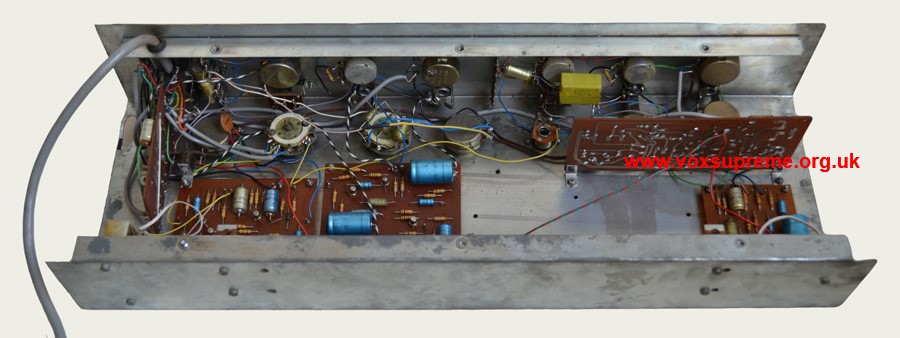
Pre-production Defiant. From left to right: mixer board (standing transversely); reverb; treble channel; tremolo (to the right, above); normal channel. JMI and its contractor (Burndept) experimented with different positions and formats for these boards during the second half of 1966.
NORMAL CHANNEL BOARD: as Thomas (June 1966 circuit diagrams), not as standard JMI production amplifiers (1967).
BRILLIANT CHANNEL BOARD: not as Thomas. Aligns with JMI production amps (though not identical). All known JMI pre-production amps have variable distortion though - including the Conqueror displayed in London in August 1966. When Thomas did come to work it in later (see yesterday's entry), it was invariable, either on or off.
TREMOLO BOARD: still to be examined, but likely to be much as Thomas. Allowing for a few differences here and there the Thomas circuit aligns with the one found in JMI production amps.
MIXER BOARD: entirely different from Thomas. The circuit is much the same as the one in JMI production amps.
REVERB BOARD: not as Thomas. Aligns with JMI production amps (though not identical).
These for the time being are the bare facts.
29th June
The famous fancy Conqueror footswitch with indicator lights, photographed at the Trade Fair in London, late August 1966. In later '66 the familiar ovoid three-button switch appears. Ultimately this alone was produced. So far as one can tell, nothing further came of the fancy switch (in the 1960s at least).
The earliest production Thomas solid state amps - the V14 and V114 (where the Super Beatle is concerned) - had a plain three-button unit to start with however, much as the simpler Jennings footswitch in terms of function, but switching MRB (with a momentary switch) rather than distortion.
With the introduction of distortion in later '66, Thomas produced a four-button version, this time with a lamp.
Safe to say, JMI was prime mover in both respects. Distortion, recommended by Denney in late 1965 / early 1966, evidently did not find favour with the Thomas engineers, presumably Jacobsen included, early on.
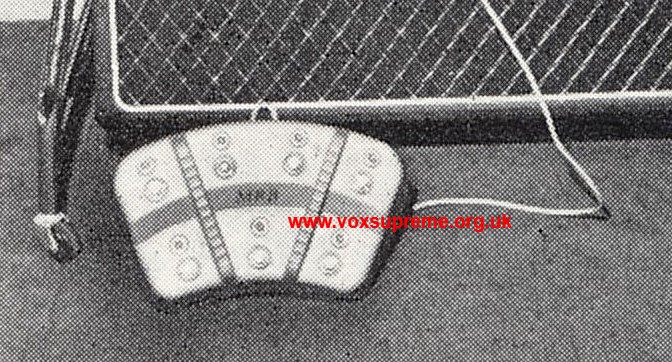
London, late August 1966.
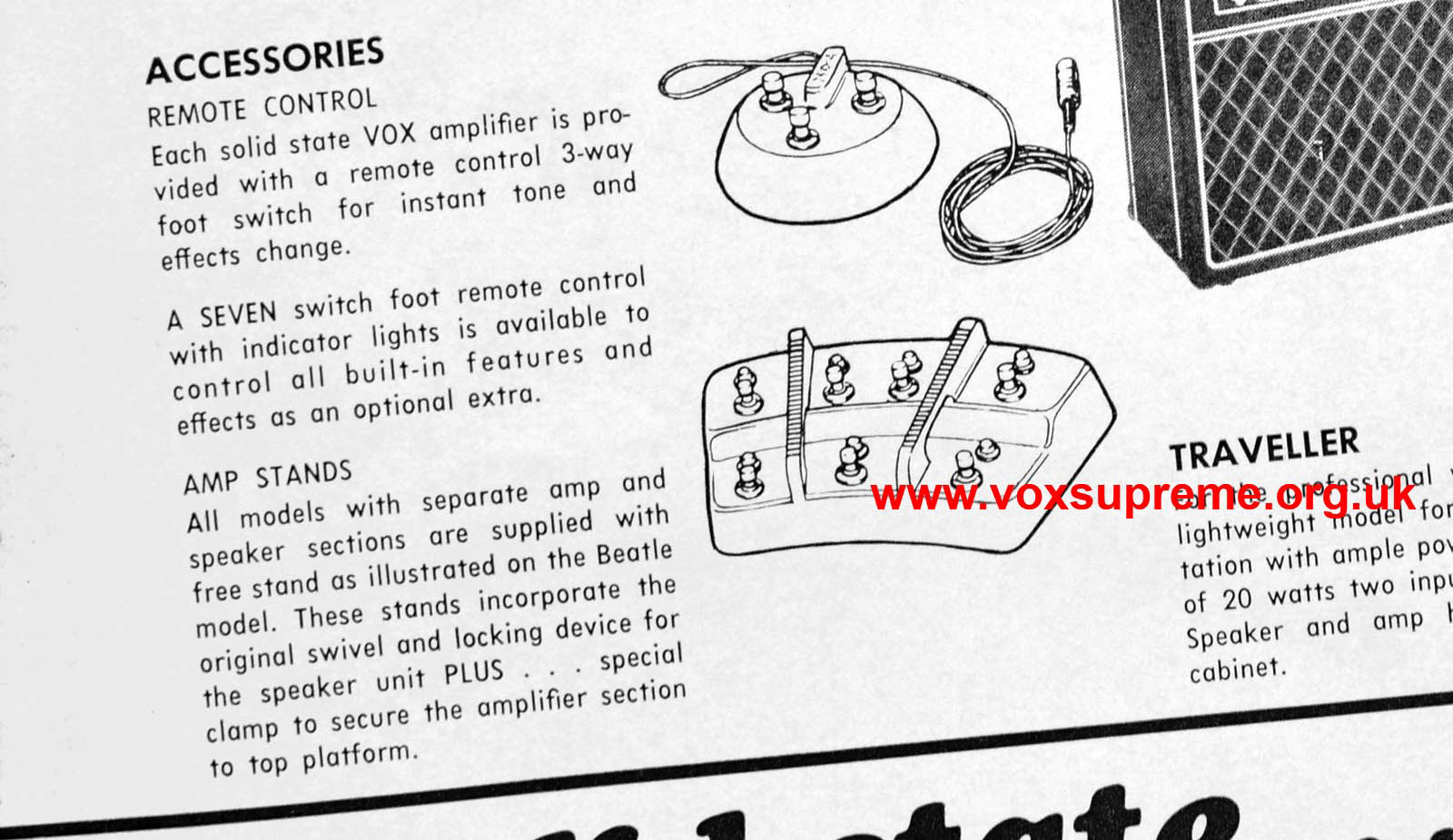
Detail from the JMI solid state catalogue drawn up for the Australian market, late 1966.
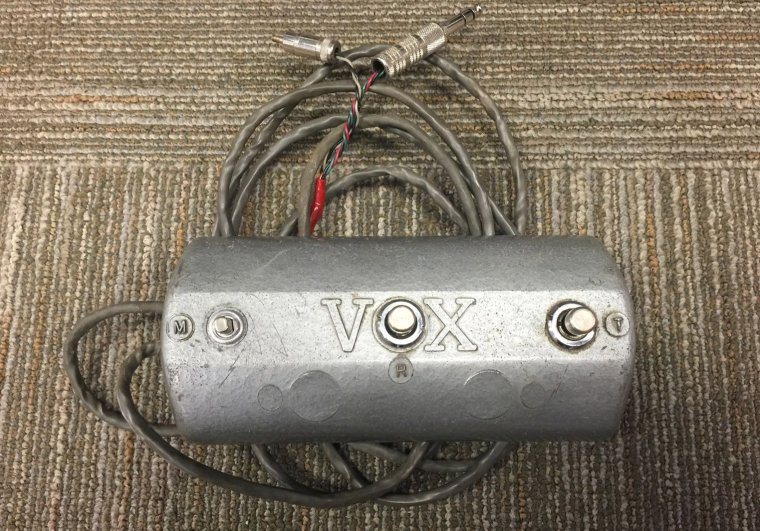
Note the "knock-outs" for further switches. The smaller roundels were for letters to designate the effect in view however, not lamps, as only the larger blanks go all the way through the case.
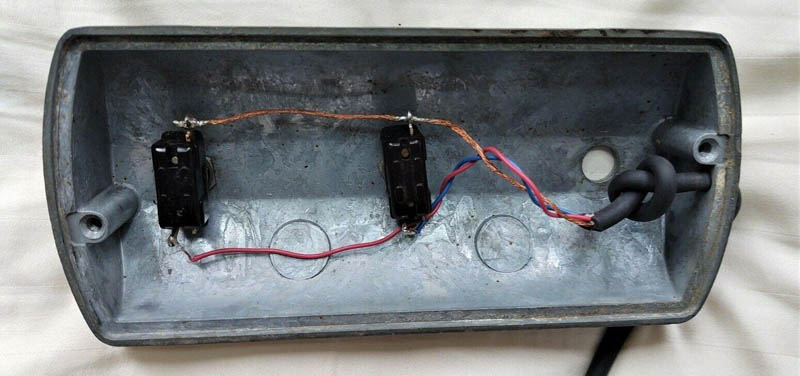
Detail of another early three-button unit, the MRB switch removed.
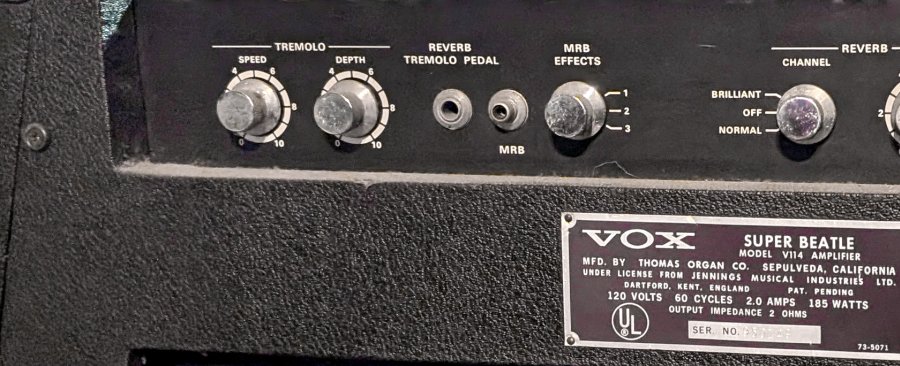
Detail of a Super Beatle V114 and its switch above.
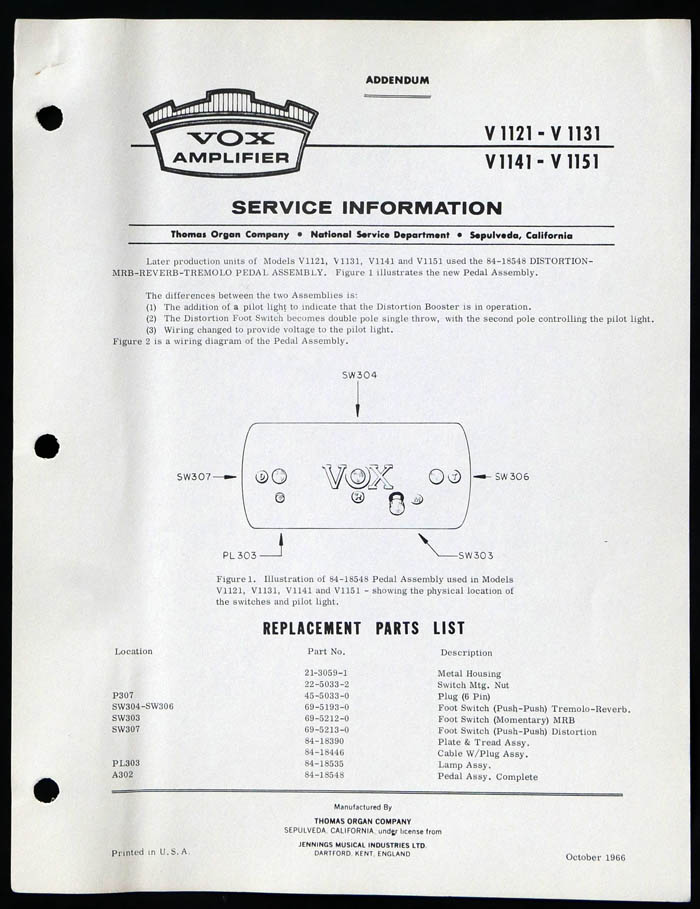
Thomas Organ service addendum dated October 1966.
28th June
OK - in order to separate out the various strands in the development of the JMI and Thomas Organ solid state lines, an annotated chronology is required. There are for instance a number of difficulties in Sava Jacobsen's letter published on the Vox Showroom website, some outlined on various forums a few years ago.
Questions naturally arise also - sometimes related - from the report made by Warwick Electronics (effective owners of Thomas Organ) of Dick Denney's visit to Sepulveda in October 1965 published in "The Vox Story", ed. Denney and Petersen (1993), pp. 141-146, Denney ever the diplomat (well, for the most part - we'll come back to that).
The new Thomas Organ range was displayed and demonstrated for the first time in public at the Hilton Hotel in New York, late June / early July 1966, i.e. 10 or so days before the NAMM Show in Chicago. The NAMM Show was the more important of the two events though. The earliest advert for the new amps in the American music trade press is from June, nothing prior to that so far.
The new Fender solid state range was shown for the first time to general public and trade at the 1966 NAMM Show too (10th-14th July '66).
JMI's Conqueror and Supreme were displayed and demonstrated at the Russell Hotel Trade Show (in London) in late August '66. Whether bass models were exhibited is not known at present. One person who may know, and who was at the show, is still around (the question asked).
As the chronology may take a little time to set out properly, certain ancillary things will be illustrated in the meantime.
27th June
Some notes on JMI's work on transistorisation in the late 1950s and early 1960s - simply an overview of the main items. Safe to say there was naturally a good deal more than is mentioned below. The Tonebender is too much of a hot potato still.
1959: - a transistorised add-in effects module for Jennings organs. The effects offered were: percussion, echo, vibraphone, harpsichord, chimes, bells, celeste, marimba, glockenspiel, harp and piano. Some of these are likely to have been re-purposed later for the Guitar Organ.
1962: - a large number of accessories and instruments, principal among which: the Vox T60 amplifier (with transistorised tremolo); the Continental organ; and the Radio Microphone. It is likely that Denney began work on the Guitar Organ at around this time.
later 1964: - Dick's prototype Guitar Organs, with a Mid Range Boost (MRB) circuit. The circuit was termed "contrast" at this point. Mid Range Boost was invented by Dick, and can be heard in a film clip (early 1965) of one of his demonstrations of a prototype Guitar Organ.
1965: - the Guitar Organ in marketable form; a transistorised front end developed for the new MC50/6 and MC100/6 Public Address amplifiers. Work on the two-manual Super Continental organ. A transistor amplifier developed for the Line Source 40 speaker columns. A set of such columns, the amplifier housed in the top of one of the cabinets, was shown at the Russell Hotel Trade Fair in August 1965.
1965/1966:- the 4- and 7-series amps. Rodney Angell, who worked at JMI from the early 1960s to 1968, was clear that the electronic design of the amplifiers (as we have them) was farmed out to an independent contractor (not Triumph, name to be given in due course). The power sections were based on circuits drawn up by Jennings in 1964. Contemporary newspaper reports record that work on the new models had been a matter of great secrecy; and this seems to have been so even within JMI. Rodney indicated that only the R&D Department (of which he was a member from 1965) knew the detail.
Late 1965: - Dick Denney assists Thomas Organ, his activities (at that point) recorded in "The Vox Story", ed. Denney and Petersen (1993), pp. 141-146 (well worth looking out).
1965/1966: - work begins on the new fully solid state range. The line generally used to be that the project would have been realised sooner were it not for the unreliability (read "unknown track record") of silicon NPN power transistors. Early versions of the Conqueror and Supreme were at any rate shown in all their glory at the Russell Hotel Trade Fair in August 1966.
To come: the Thomas preamp boards, and the boards of two of the pre-production JMI solid state amps.
26th June
A note on "modularity" - standardised interchangeable chassis or assemblies, as in the case of JMI's solid state preamps, a Treble version common to the Virtuoso, Conqueror, Defiant, and Supreme; and a Bass version common to the Dynamic, Foundation and Super Foundation Bass. Power sections were common in pairs according to output: 30W for the Conqueror and Dynamic Bass; 50W for the Defiant and Foundation Bass, and so on.
The first company to embrace modularity in any serious way in the United Kingdom seems to have been Audix, which brought a range of Public Address amplifiers to market in 1961/1962. Different types of front end (suitable for required purpose) could be swapped in and out. Power sections were available in 15W, 30W, and 60W versions - which turned out to be three of the increments adopted by JMI for its 4- and 7-series amplifers in 1966. Audix advertised its designs mainly to (and through) the "Association of Public Address Engineers". Jennings joined the Association in 1963.
And it is probably no accident that Jennings's first range of modular amplifiers was not the 4- and 7-series, but the "Metal Clad" Public Address amps, introduced in 1964. The 30W, 50W, and 100W Metal Clads had a common preamp (same size, same circuit), only the power sections differed. The preamp of the 15W version followed the designated circuit but was built on a smaller assembly.
Thomas Organ took its cue from JMI. As has been mentioned, the company's engineers had no experience whatsoever of guitar amplifier design and manufacture before Jennings came along.
A short history of the company written in the 1980s records the sad spectacle of Thomas salesmen in Beatles wigs trying to sell equipment they simply didn't understand. This was not, however, universally the case. Good numbers of dealers knew exactly what was what. Marv Kaiser, the head of Thomas's Vox sales division, was a key driving force.
That Thomas Organ solid state amps should have been modular is no real surprise though. Some notes on their mind-boggling wiring to come. A multitude of sins buried deep in the case of a console organ is one thing, a guitar amplifier preamp ...
Below, a quick shot of one of the adverts placed by Audix in the trade press in 1962:
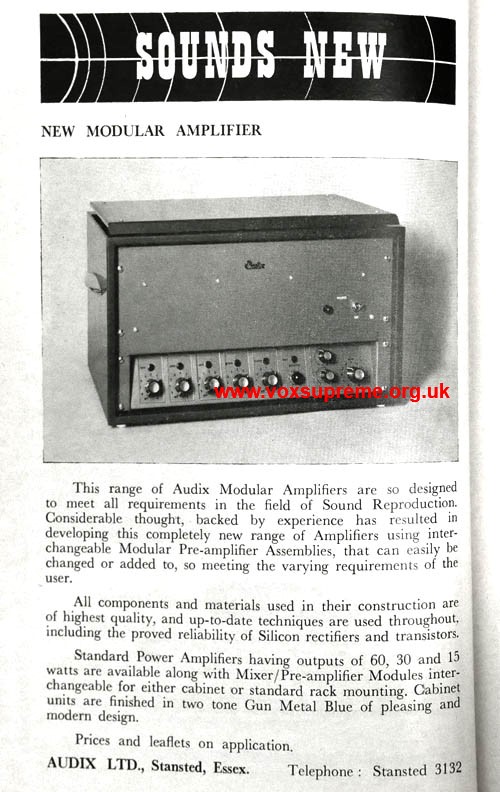
Audix advert, 1962.
25th June
Posted yesterday on the updates page of the Vox T60 website: - One thing that has been lost sight of in commentary on the Vox T60 amplifier is that the topology of its power section (as it stood in 1963) was used some years later by JMI for the range of state amplifiers introduced in 1966-1967: the Traveller, Virtuoso, Conqueror and Dynamic Bass, and the Defiant and Foundation Bass. The Supreme and Super Foundation Bass differ in certain respects, but their lineage is clear.
The claim, sometimes made without qualification, that this range was somehow simply a poor cousin of the solid state range marketed by the Thomas Organ Company (Sepulveda, California) - the Vox Buckingham, Vox Super Beatle, and so on - unfortunately does not wash. One has to remember that Thomas did not enter the business of designing and manufacturing guitar amplifiers until JMI came along. In the autumn of 1964, Jennings appointed Thomas the sole distributor of JMI equipment in the USA. Up to that point Thomas had only made and sold organs and accessories.
As for those organs, there is nothing remotely similar to the T60's power section (scores of Thomas circuit diagrams survive). Transistor circuitry was confined to voicings and effects. And just to note, JMI had its own transistorised organ effects unit too - in 1959.
As the "Vox Story", ed. Dick Denney and David Petersen, revealed long ago, one of Dick's tasks in late 1965 was to advise Thomas on the development and fitting out of its new range of amps. One of the items presented for comment was an engineering prototype of the solid state Super Beatle, which evidently took some months to bring to saleable form (first advertised publicly in June/July 1966).
In early 1966, David B., an occasional contractor for JMI, happened to be present when a Thomas-made amp sent from the States - presumably solid state - was put through its paces at the Vox Works in Erith. Unfortunately it turned out that the engineers at Sepulveda had either misunderstood or deliberately altered the circuit that JMI had supplied. The result was a source of some concern and amusement (Dick and Derek Underdown are said to have almost fallen over laughing). Nothing is known at present of the tenor of the response made to Thomas.
More to follow in due course.
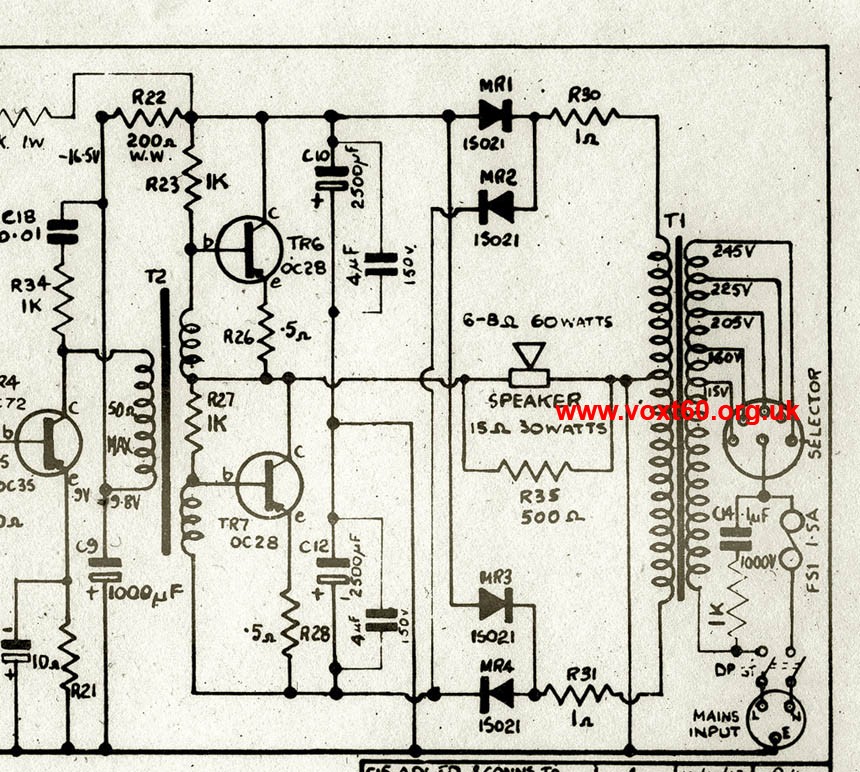
Detail of JMI circuit diagram OS/062 for the T60, germanium PNP transistors. JMI unforttunately failed to include the variable bias resistors recommended by Mullard for such circuits, something that simply added to inherent difficulties. The circuit would only work properly if everything - transformer windings, currents, voltages, resistances, etc - was perfectly balanced.
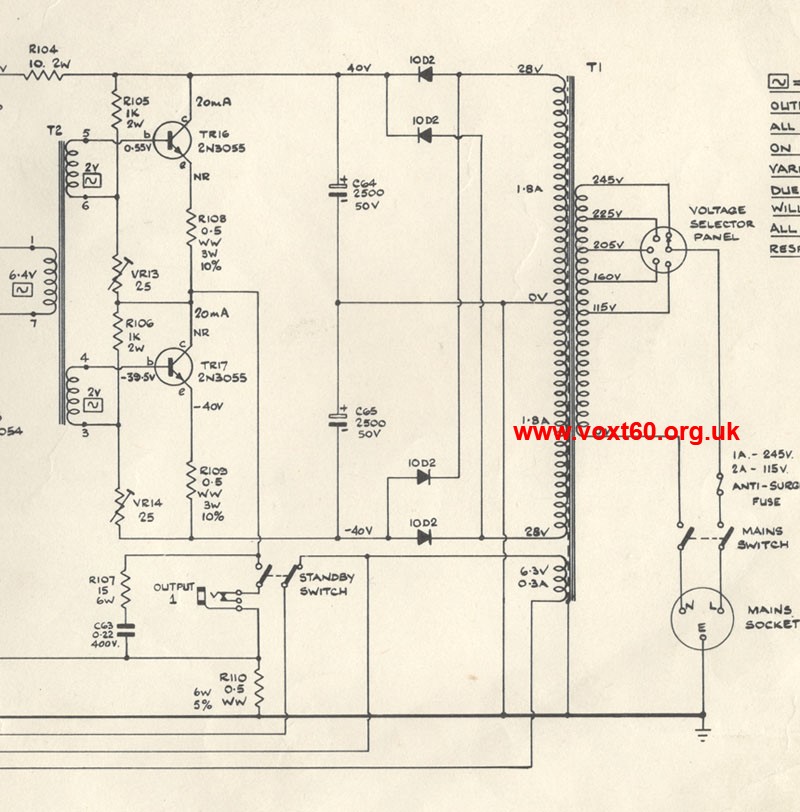
Detail of JMI circuit diagram OS/133 for the power section of the Vox Conqueror and Dynamic Bass, silicon NPN transistors thoughout.
Below, a list of Thomas Organ Company transistor part numbers and types from its pocket manual (for dealers) of later 1966. The "Original Equipment Number" is the number given for the transistor or transistors in the parts lists for the various models in the Thomas "Amplifiers Service Manual".
Thomas rarely disclosed the conventional (commercial) name of transistors - i.e. the 2N3055 and so on - in its service manuals. Even the pocket manual only discloses the "Emergency Commercial Substitution Number" occasionally.
- Seven amps had germanium output transistors: the Pathfinder (V1011); the Pacemaker (1021); the Essex Bass (V4 and V104); the Buckingham (V12, V112, and V1012); the Viscount (V15, V115 and V1015); the Cambridge Reverb II (V1031); and the Berkeley Reverb (V1081).
- Two had 2N3055s: the Royal Guardsman (V13, V113, and V1013); and the Super Beatle (V4 and V114). It may be that the very earliest amps had something different. There are unverified reports of germanium.
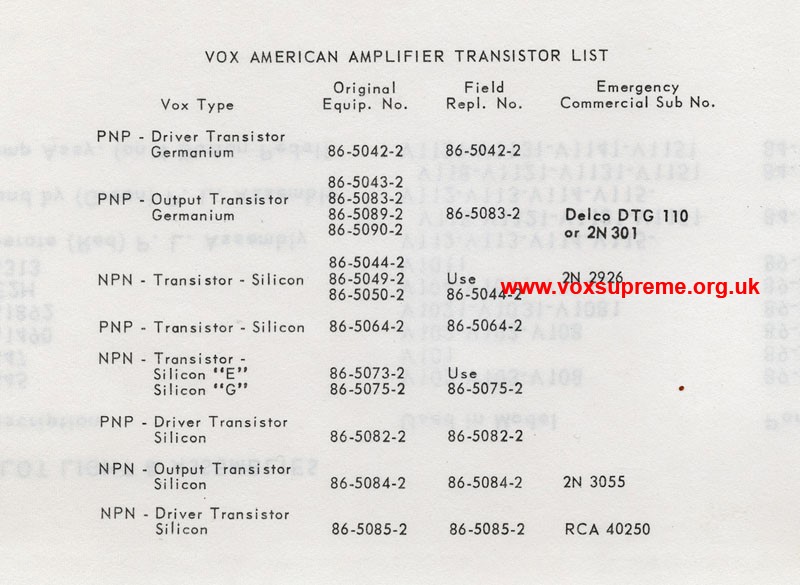
Late 1966, Thomas dealer manual.
UPDATES 2012-2026
Updates November and December 2021.
Updates September to December 2020.
Updates August to December 2018.
Updates for June and July 2018.
Updates for January to May 2018.
Updates for November and December 2017.
Updates for September and October 2017.
Updates for July and August 2017.